Me in the shower: *writes a novel, its prequel and 5 sequels in 6 different languages. The words flow perfectly. Its plot is intricate. The characters are complex and 3D. It’s heartwarming and tear jerking. It’s perfect. The flowers are blooming. The bees are saved. There is world peace.*
And all these people call in, sharing their own memories of this mysterious Cryptid named Logan who is apparently an immortal, grumpy, wandering dad-friend who’s also a patriot and he helped punch out Nazi’s and free camps and beats up assholes who don’t respect women. And the whole while Logan is watching this from a TV screen with Kitty or Rogue holding his hand so gently, after they dragged him to the couch in a hurry. “You recording this?” “Don’t worry, we won’t let you miss a single word.”
Okay but if we’re gonna do this we’re gonna do this HARDCORE HISTORIAN STYLE, and it initially comes up while Steve is being interviewed for a book about the Howling Commandos or a bit for the History Channel or something. Because this person is like “Hey, there are a bunch of stories of you showing up somewhere with only one dude for backup, was that Bucky?” And we’ll assume that this is before the whole Winter Soldier thing, so that’s not a hideously loaded question.
And Steve kind of laughs and he’s like, “Oh, wow, God, that was actually this dude on detached duty from the Canadian special forces, he and I got sent on a bunch of missions together. His name was Logan, he was the weirdest guy I ever met, and I knew some pretty weird guys, but he could take a hit even better than I could, so when the Howlies were laid up, they sent us out together.” And he launches into this story about how one time he and Logan stole a plane complete with pilot and stormed a prison camp that was holding German Jews before sending them up to Poland, and the historian he’s talking to is taking frantic notes and trying not to drool because THIS IS A NEW GUY. CAPTAIN AMERICA’S STORY IS METICULOUSLY WELL DOCUMENTED BUT NO ONE’S EVER MENTIONED THIS GUY.
There are no pictures, obviously, so Steve does a sketch for this historian, because he’s helpful like that and also because. Like. Listen. Steve’s been through a lot of weird shit, and to be sure this Logan he used to know could take a bullet and keep coming no problem, but this dude’s probably been dead fifty or sixty years. No harm in giving him a little posthumous glory, right?
So this historian runs back to her university and starts doing research on the Internet. She reaches out to her coworkers first, then to anyone else she knows, then to the premier WWII and Captain America scholars of the world, and asks all of them “Do you happen to know who the fuck this dude is?”
And like, no, they don’t. They’ve got no idea. Steve’s not even totally sure what the guy’s real last name was, because Jameson is common as hell and there’s no Logan Jameson on the books. So they start doing research into this WWII cryptid, and finally they reach an old woman who listens to her grandson’s boyfriend talk passionately about this new project he’s working on and goes “Oh, yeah, I met Cap in Germany one time, there was a guy with him who sounds kind of like what you’re talking about.”
This passionate history major immediately sends an email in all caps to his adviser and it just says “MY BOYFRIEND’S GRANNY KNOWS WHO WE’RE TALKING ABOUT PLEASE COME TO KANSAS ASAP THANKS” or whatever, because, listen, historians are Like That. Speaking as someone who could easily have claimed to be a history major based on my thesis, I would have gone to Kansas in 0.2 seconds if someone had been like “What’s up we found that book you were after but we can’t take it out of the museum.” It does stuff to you. Trust me here.
So this woman tells the story of how Cap and his weird buddy broke her and her mother and father out of a temporary prison camp, and this history professor immediately takes all the tiny bits of information and starts asking around, looking for literally anyone else who knows this Logan dude. He saved your ass one time in Paris? He gave you some rations in Berlin? He beat your grandfather’s ass in Russia? He took three bullets for you? You had a passing conversation? This historian and his extremely pumped undergrad who just changed his senior thesis want to hear about it.
And then someone gets in touch with them and is like “Hey, I know you’re looking for WWII stories, but this guy saved my dad’s entire unit on the Somme and I have pictures?” And someone else is like “Hey, I have a file from a Vietnam MASH unit for a Logan who looks like that guy, do you want it?” And someone else is like “Uh, fuck all of y’all, I think this is him in the Civil War, what do I do about that?”
AND SO BEGINS LOGAN, THE HISTORICAL CRYPTID.
This undergrad is taking an extra year of college and basically getting a Bachelor’s degree in Tracking Weird Mutants Through History, and also his adviser is very lucky to be on tenure, because otherwise he would have been laughed out of the college three times by now. But there is an absolute preponderance of evidence, is the thing, so it just turns into this massive quest to investigate exactly whether or not Logan the Mystery Dude was actually in China for the Boxer Rebellion or whatever.
Forget this being a collaborative effort between colleges, there are multiple continents involved in this by now. Canadian government is under pressure to turn out their WWII special operations files for this guy from five different big name universities in five different countries, including their own. Things are getting a little wild in academia. Steve’s been interviewed nine times and he has a filter set up in his email specifically to catch stuff from the University of Toronto.
It takes a little bit for Kitty’s bubbe to get a phone call. Kitty’s bubbe has been living a quiet-ass life in Illinois and likes it that way, especially because her last name is not Pryde and therefore Kitty and her weird friends can crash at Bubbe’s house whenever they’re in the area without any trouble. It’s fine if her granddaughter wants to run around in spandex and save the world and shit, she’s honestly much more chill about it than Kitty’s parents, but Bubbe does not care for news crews in her neighborhood thank you very much.
But so eventually this nice old Ashkenazi woman gets a phone call from an extremely pumped undergrad who read a very brief statement she gave in a news article forty years ago about Captain America, who she is very grateful to for breaking her, her older sister, and their little brother out of a prison camp during WWII and also helping them get across the border. Did she happen to see anyone else? Why yes, very polite young man, the Captain had another man with him, he was very grumpy but he let my brother ride on his shoulders so I liked him very much. That’s great, would she mind if someone came and talked to her about that? No, very polite young man, not at all, when would work for you?
And she gives Kitty a call that night, because she gives Kitty a weekly call since Kitty and her parents are going through a rough spot to the tune of “please God stop risking your life//listen I’m saving people I’m not going to stop learn to cope”. Bubbe mentions offhand that she’s going to have a talk with this very polite young historian about the Shoah and Kitty’s understandably a little concerned for her bubbe’s mental health, and asks some questions.
So Kitty hears her bubbe out in increasing degrees of shock, hangs up the phone, and immediately goes and does an extensive google.
Then she goes and hammers on Logan’s door until he says to come in, slams her computer down in front of him, and says “Holy shit, Logan, why didn’t you tell us that you knew Captain America?”
“Uh, because I mostly didn’t,” Logan says, wary. “Don’t remember that much.”
“You might want to take a look at this, then,” Kitty says, and Logan looks through her fifteen tabs and thanks her and calls the university that seems best informed.
Which is the story of how an extremely pumped undergrad gets a phone call from the object of his thesis that opens with “This is gonna sound pretty fuckin’ wild, but my name is Logan and I’m pretty sure you can catch me up on the last hundred years better than I can.”
Oh, and then Logan and Steve meet up again and it’s very nice and sweet and that undergrad gets a full ride to the PhD program of his choice. The full ride’s name is actually Tony Stark, who’s doing a favor for Steve, who’s doing a favor for Logan, who’s secretly doing a favor for the undergrad, but no one really knows that.
I wanted to type up a little rundown of quick n dirty writing tips based on things I see a lot in fic/ amateur original manuscripts, and, uh, it turned out that they all revolved around POV. Nailing point of view in fiction writing is both crucial and one of the least intuitive building blocks of writing to learn: an understanding of POV has been the only useful thing i took from my college creative writing classes, and god knows how long I’d have stumbled along without it otherwise.
So! I am saving you, baby writer, the trouble of slogging through a miserable writing class with a professor who’s bitter as FUCK that genre fiction sells better than his “sad white man drinking” lit fic novels. Here are some assorted writing tips/ common mistakes and how to fix them, as relating to POV:
(this turned into a WALL OF TEXT so i will be using gifs to break it up)
>“I watched the ship tilt” “he saw the sky darken” “she noticed flowers growing on the rusted gate.” no. If the character who felt/saw/noticed etc is your POV character, whether in first or third, then this is called filtering and it takes the reader out of the story by subtly reminding them of the separation between the POV character and themselves. in most styles of writing, this is bad, not to mention it unnecessarily complicates your prose. try again: “the ship tilted.” “the sky darkened.” “flowers grew on the rusted gate.” Readers will instinctively understand that the POV character is witnessing the story happen, they don’t need to be told it.
I’m not telling you to never refer to your character “watching” something, of course: “I watched the birds dart around for hours,” isn’t filtering because watching is a notable activity, here, rather than an unnecessary obfuscation of the “real” thing happening. But understand how phrasing can jar readers momentarily apart from the character viewpoint, and use it with intention.
> Close Third Person POV still requires you to be mindful of your POV character. this is a rookie mistake i see allllllll the time. “Josh cried stupid tears at the beautiful display by the dancers,” is a sentence in Josh’s POV. “Stupid” tells us how he feels about the tears, “beautiful” tells us how he feels about the display. ok. all good so far. BUT.
“Josh cried stupid tears at the beautiful display by the dancers. It was everything he’d wanted from this production, from the lighting to the costumes to the exquisite choreography. Martha had to suppress a fond smile at his reaction; he was always so sweetly emotional after the curtain fell.”
Do you see what’s wrong with this paragraph? The first two sentences are Josh’s POV, and then the third one suddenly becomes Martha’s. A lot of amateur writers don’t even realize they’re doing this, which in its most egregious form is called “head-hopping,” but it’s disorienting and distracting for the reader, and makes it harder to connect with a single character. In multi-person close 3rd POV story, the POV should remain the same for an entire chapter (or at least, for an entire scene/ segment,) and change only between them. If you’re new to POV wrangling, watch your adjectives/ interiority (we’ll get to that in a second) and think “which character am I using as a lens right now, and am I being consistent" every once in a while until you get the hang of it.
> Related: let’s talk about interiority. Interiority is a more sophisticated way of thinking of a character’s “internal narration,” IE bits of prose whose job is not to advance the plot, set tone, or describe anything, (although it CAN do any of those things as well, and good prose will multitask) but to give us a specific sense of the character’s internal life, including backstory, likes, dislikes, fears, wants, and personality. In the above example paragraph, the middle sentence “It was everything he’d wanted from this production, from the lighting to the costumes to the exquisite choreography” Is interiority for Josh. It tells us that not only did he love the show, he’s very familiar with this art form and thus had expectations going in; likewise, listing the technical components is a way of emphasizing his enthusiasm while pointing out that it’s informed, implying that Josh himself is intellectually breaking down the performance even in appreciation.
“That’s a lot for a throwaway sentence you made up for an example.” Well, yeah, a little interiority goes a long way. Interiority is what creates the closeness we have to POV characters, the reason we understand them better than the non-POV characters they interact with. It’s particularly key in the first couple chapters of an original work, when we need to be sold on the character and understand the context they operate in.
If readers are having trouble connecting to or understanding the motivations of your character, you might need more interiority; if your story’s plot is agonizingly slow-moving (and you don’t want it to be) or your character is coming off as melodramatic, you might need less. It’s not something you should necessarily worry about; your amount of interiority in a WIP is probably fine, but being able to recognize it for what it is will help you be more mindful when you edit.
(Fanfic as a medium revels in interiority: that’s how you get 10k fics where nothing happens but two characters lying in bed talking and having Feelings. Or coffeeshop AUs that have literally no plot to speak of but are 100k+ long.)
>try not to describe the facial expression of a POV character, even in third person. rather like filtering, it turns us into a spectator of the character when they’re supposed to be our vessel, and since it’s *their* POV, there should be other ways available to communicate their emotion/ reactions. There are ways of circumventing this, (the example sentence where “Martha had to suppress a fond smile” is an example) where their expression is tied up in a physical action, or something done very deliberately by the character and therefore becomes something they would note to themselves, but generally, get rid of “[pov character’s] eye’s widened” and “[pov character] smiled.”
so that’s what i got! go forth and write with beautifully deliberate use of POV.
If y’all use a decent box mix and use melted butter instead of vegetable oil, an extra egg, and milk instead of water, no one can tell the difference. I sure as hell can’t.
Also, if you add a little almond extract to vanilla cake, or a little coffee to chocolate cake, it sends it through the roof.
This concludes me attempting to be helpful.
yo I can vouch for this I’ve done this for the last few cakes I’ve made and holy crap it makes suuuuch a difference the cake is still fluffy, but it also seems more dense, and it doesn’t dry out like at all you can leave it uncovered on the counter all day after being cut into, and it won’t get all crusty and dry this is an amazing way to take your cakes to the next level
Does this count as cake hacks?
cake: hacked
OK but if you’re adding all that to the mix why not just scratch bake? There are literally only four ingredients you’re NOT adding yourself at this point.
It’s always so baffling when mix hackers give you a whole ass cake recipe. Like there’s some kind of magic to mixes that needs to form the core of the thing instead of just, a couple dry ingredients and powdered milk.
presumably as a step of intermediate complexity between mix baking and scratch baking, when neither of those fits your complexity needs exactly?
In particular, this is a useful technique for people living in dorms, or traveling, or similar situations!
Baking from scratch means you’ve got to buy a whole tin of baking powder and only use a spoonful, and a whole thing of flour, and maybe multiple kinds of sugar, and maybe cocoa powder, maybe spices, and there’s no way you’re going to use up any of those, you’ll just have to pitch them when you move out.
Not to mention that you’ve got maybe one measuring cup, and there’s no way you’ve got a sifter, and you probably don’t have measuring spoons and how sure are you that your eating spoon is actually the right size…
Scratch baking is great if you’re going to do it regularly! But for situations where it doesn’t make sense to invest in all the tools and ingredients, cake mixes are very practical.
Scratch means you have to worry about ratios. Scratch means you have to keep cake flour on hand. Scratch means you don’t get the benefit of some of the CHEMICALS in the mix that are 100% beneficial to excellent cake.
I bake some things from scratch. Anything requiring creaming a mix is basically a sad joke because all the work is the creaming. Standard cake is not one of them.
Of course, me being me, a standard cake is usually just a component – I don’t actually like “just cake” that much and canned frosting is terrible. So while I don’t scratch bake cake, that cake is getting saturated with tres leches, or put in a trifle, or getting add-ins before baking anyway.
But in a larger sense, who cares? Baking is hard and for fun anyway. Why bake-shame someone?
Just FYI… A LOT of professional bakers (probably more than half) in the US at least use doctored mixes rather than scratch ingredients even for their more expensive cakes like wedding cakes. There are whole forums where they talk about this amongst themselves.
In taste tests they’ve found that while customers may ask for a cake from scratch they often end up preferring the taste and texture of the doctored mixes when all is said and done.
Unless you have some particular allergies or some other reason to avoid box mixes they are often the better way to go.
I’ve been looking into opening up a home bakery and part of the task of producing food for the public is making sure your items are standardized so that every person who gets a cupcake (for instance) is getting the same quality, size, etc., etc.
Doctored mixes really help with that since big companies like Duncan Hines buys in larger quantities, can afford to test/discard bad batches and will rarely have a one-off batch of flour or flavoring that are bad or go bad like you can at home.
Nice seeing this going around again!
My standard cake is box mix + milk for water + melted butter for oil + dash vanilla extract + frosting from scratch. This really seems to hit the right spot for people of “mmm, homemade” but also “exactly like Mom used to make.” (Do that for a yellow cake with chocolate buttercream frosting, add candles, and serve to a college student, for the maximum “this is exactly what I didn’t want to admit I wanted” potential.)
Seconding the addition of coffee to chocolate cake; a tablespoon of instant coffee powder in a dark chocolate cake makes it taste chocolatey-er without actually adding a perceptible coffee flavor (I don’t like coffee flavor, personally, and I still do this).
Another good option is a box lemon cake mix plus maybe 3 lemons. Zest the lemons, set the zest aside, then juice them and use that in place of the water; then use the zest to flavor the frosting. Adds a nice fresh kick.
Chocolate chips can be dumped straight into chocolate cake mix without fussing with anything to compensate. Sprinkles can go into white cake mix to make your own “confetti cake” with any specific color combo you like. Any kind of dried fruit can be chopped to raisin-size, soaked in hot water (or, better yet, hot juice with a couple of citrus peels added) for an hour, drained, and then added to batter.
Replacing part (up to maybe 1/3) of the water with yogurt (and then the rest with milk as usual) will give you a denser cake; make sure to check if it’s cooked through, and bake a little longer if necessary.
Swirling things through batter for that fancy marbled look is easy. Consider melting chocolate chips with butter, or mixing brown sugar with cinnamon and a little melted butter, or making up two different cake mixes and swirling those together.
I swear by the Cake Mix Doctor’s two cookbooks (one’s general, one’s specifically for chocolate cakes). I think every birthday cake I had as a child was out of those.
I started in my early days by using Betty Crocker mixes – an expensive import in Northern Ireland at the time, but very convenient since some of them were complete kits including a foil cake-tin. They also included cakes I’d never heard of – Red Velvet, Devil’s Food and Angel Food (why not Angel’s Food?)
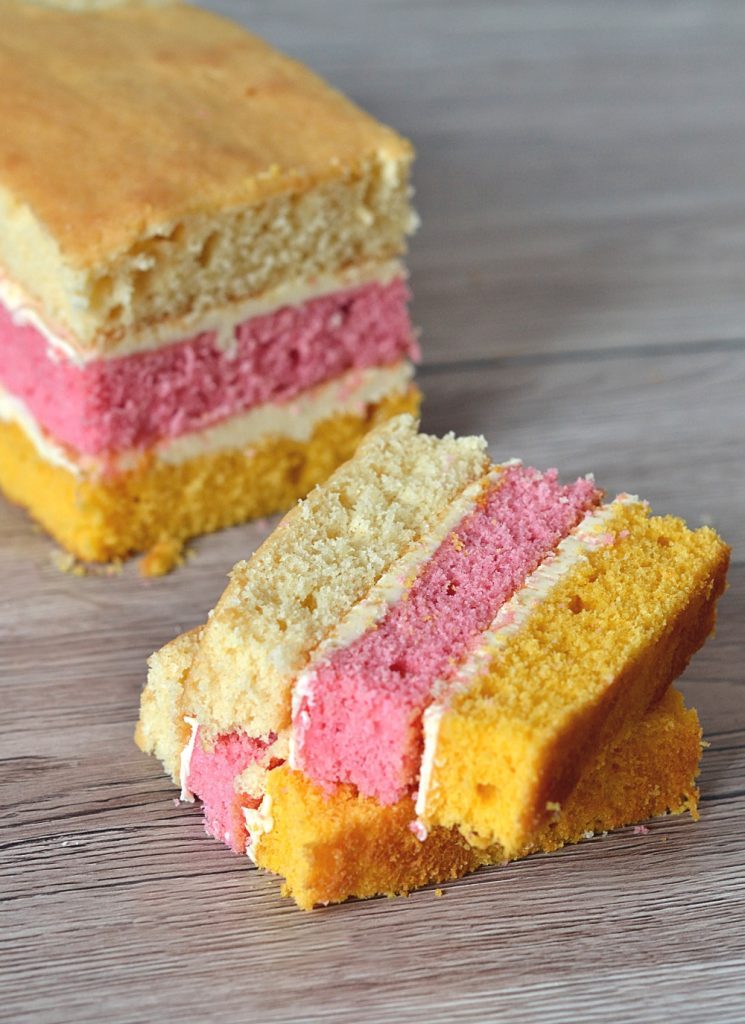
NB, Angel Cake over here is a completely different thing made up of coloured layers.
After a while, with my Mum’s help, I started tweaking with an extra egg here, a bit of cream there, and the results were always good.
Though @dduane is a far better
cake-baker than I’ll ever be, she also uses mixes to see how they stack up
against made-from-scratch versions especially if the mixes produce something
Really Nice – like, for instance, Betty Crocker brownies – or are more convenient with no huge drop in quality…..
Here’s an example: about 10 years ago
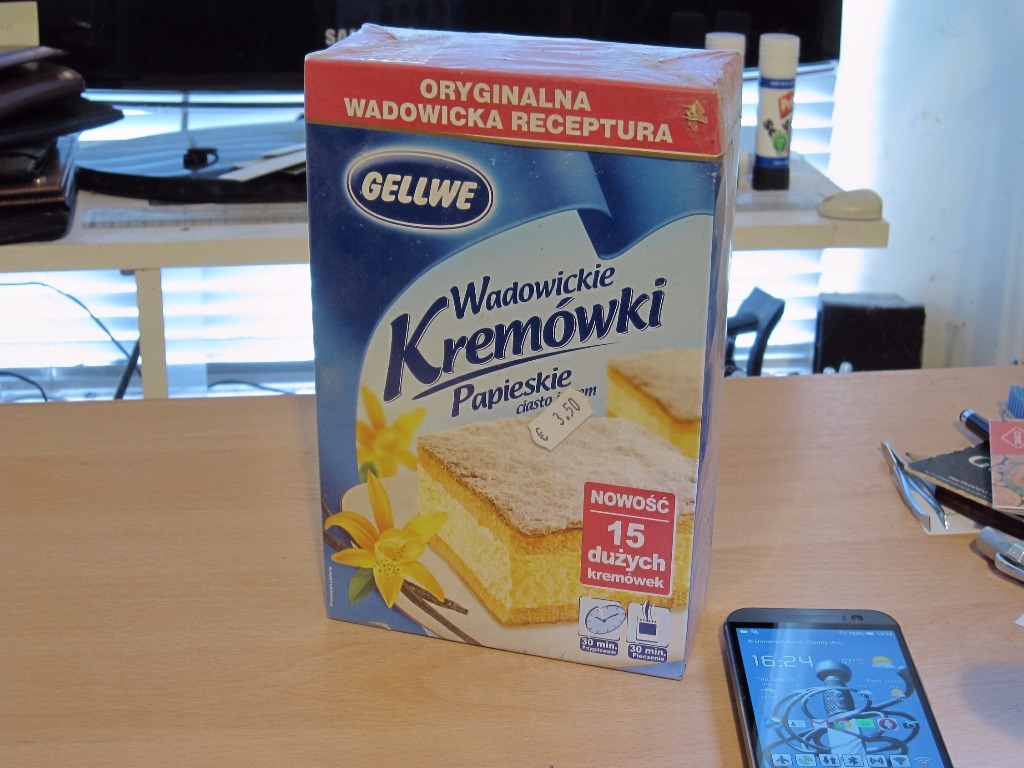
Kremówka Papieska / “The Pope’s Cream Cake” was mentioned as one of the EU 50th-birthday cakes, and DD made it from scratch.
A bit later we found Gellwe-brand mix in one of our local branches of Polonez, and tried that too. The home-made one was definitely better, but the boxed version was also very good, needed only basic extras – milk, butter, sugar etc. – and took far less time to make (though after tasting the custard we added a bit extra vanilla extract…)
That’s why we still have a box in the store-cupboard.
Just in case one or both of us feel like pontifficating… :->
Me in the shower: *writes a novel, its prequel and 5 sequels in 6 different languages. The words flow perfectly. Its plot is intricate. The characters are complex and 3D. It’s heartwarming and tear jerking. It’s perfect. The flowers are blooming. The bees are saved. There is world peace.*















 Lady Karasu