Today I learned that Van Halen have that rider in their contract about “a bowl of M&Ms with all the brown ones removed” in order to know at a glance if the promoter read the entire contract. And the reason they do THAT is because they once had a stage collapse because a promoter hadn’t read the proper way to set up all the specific technical stuff.
So if the band goes in the dressing room or catering and sees brown M&Ms, they know they have to double-check the stage setup for safety.
I heard about this on Freakonomics Radio. Turns out the bit about no brown M&Ms is HUGE, in BIG font, bold, underlined and quotated like they’re on the Group W Bench.
The band was all, “We have fifty-pound lights hanging over our heads and fire being shot out of cannons. We had to know whether they read our safety regs so we didn’t flamebroil any roadies.”
interesting how this has become a meme in the music industry about divas. i’ve always heard jokes that amount to “this stuck up celebrity hates the green gummy bears!! they’re refusing to perform just for that???” and its reading stuff like this that i realise how that joke might have come about. people get grumpy that the band refuses to play but cant admit its because THEY’RE incompetent, so they make it all about the M&Ms. another example of artists using a creative method to ensure they have a perfectly reasonable request fulfilled that is then bastardised by lazy people who wanna make money off them.
…this is like the music industry version of hearing the truth behind the McDonalds hot coffee lawsuit
I remember hearing someone complain about Prince’s super detailed set-up for his stage performances – how the piano was supposed to be angled compared to the guitar and the pedals and microphone, and ‘ugh I can’t believe he wants us to measure how far his piano must be from his guitar holder’ and I told him that, how would he feel if, every single morning when he got to work, his desk had moved and his computer was on the wrong side of the table, and now your files were all messed up so you couldn’t work?
Changed his perspective.
Always respect your entertainment artists. Always.
A thing that is now happening: arguing tiny points of characterization – actually, not even that, just a random background details? – by ficlet. Here’s my contribution, and @xparrot had better post hers soon because it is adorable and breaks my heart. (I am maybe even willing to concede the point because it’s so good!)
“Hey Da Qing, it says here that cats can’t see color,” Yunlan says, frowning.
“They can’t.”
“But you can!”
“Yashou see color.”
“Oh. Okay. Well – do you know why cats like to knead things with their paws? It says that perhaps, um. Yeah, they don’t really know?”
“It feels good,” Da Qing says with a sniff. “Why else would you do it?”
“Mm, I don’t know. It says cats rub their faces on things to make them smell like them…?”
“And it feels good when things smell like you. Right?”
Yunlan giggles. “Da Qing. Humans can’t smell stuff like that!”
“Really?! But I thought that’s why you kept stealing my blanket! Because you wanted it to smell more like you.”
“Da Qing. We only have one blanket. It’s not your blanket.”
“I put my smell on it the night we got it from Mrs Wang!”
“How was I supposed to know?!”
Da Qing huffs. “Your sense of smell really is pathetic.”
“That’s because I only have… Let’s see. What did they say? Oh yeah. Five million smell-things. Um. Those.”
“And cats?” Da Qing asks, smug.
“Up to – 80 million?! Wow. That’s a lot.”
Da Qing preens. “Cats really are superior in every way,” he says.
“You sleep on average sixteen hours a day,” Yunlan retorts.
Why this scene is listed as one of my favorite Guardian’s scenes:
After the death of the Dixing-ren, which happened right before this particular scene, Shen Wei was devastated because he, once again, failed to save his own people. The usually calm and collected Shen Wei, gazed towards the empty pillar; his skin icy and pale as if he’s drowning in sorrow. He stood on top of the platform, looking dejected. He was crestfallen at the catastrophe that’s in motion because of his own brother.
I still can’t get over the openness and innocence in baby Shen Wei’s face. How can this be the same actor? The face is the same but he looks so much younger. WTH is this sorcery Zhu Yilong?!!?!
As someone who originally trained as a social historian of the Medieval Period, I have some things to add in support of the main point. Most people dramatically underestimate the economic importance of Medieval women and their level of agency. Part of the problem here is when modern people think of medieval people they are imagining the upper end of the nobility and not the rest of society.
Your average low end farming family could not survive without women’s labour. Yes, there was gender separation of labour. Yes, the men did the bulk of the grain farming, outside of peak times like planting and harvest, but unless you were very well off, you generally didn’t live on that. The women had primary responsibility for the chickens, ducks, or geese the family owned, and thus the eggs, feathers, and meat. (Egg money is nothing to sneeze at and was often the main source of protein unless you were very well off). They grew vegetables, and if she was lucky she might sell the excess. Her hands were always busy, and not just with the tasks you expect like cooking, mending, child care, etc.. As she walked, as she rested, as she went about her day, if her hands would have otherwise been free, she was spinning thread with a hand distaff. (You can see them tucked in the belts of peasant women in art of the era). Unless her husband was a weaver, most of that thread was for sale to the folks making clothe as men didn’t spin. Depending where she lived and the ages of her children, she might have primary responsibility for the families sheep and thus takes part in sheering and carding. (Sheep were important and there are plenty of court cases of women stealing loose wool or even shearing other people’s sheep.) She might gather firewood, nuts, fruit, or rushes, again depending on geography. She might own and harvest fruit trees and thus make things out of that fruit. She might keep bees and sell honey. She might make and sell cheese if they had cows, sheep, or goats. Just as her husband might have part time work as a carpenter or other skilled craft when the fields didn’t need him, she might do piece work for a craftsman or be a brewer of ale, cider, or perry (depending on geography). Ale doesn’t keep so women in a village took it in turn to brew batches, the water not being potable on it’s own, so everyone needed some form of alcohol they could water down to drink. The women’s labour and the money she bought in kept the family alive between the pay outs for the men as well as being utterly essential on a day to day survival level.
Something similar goes on in towns and cities. The husband might be a craftsman or merchant, but trust me, so is his wife and she has the right to carry on the trade after his death.
Also, unless there was a lot of money, goods, lands, and/or titles involved, people generally got a say in who they married. No really. Keep in mind that the average age of first marriage for a yeoman was late teens or early twenties (depending when and where), but the average age of first marriage for the working poor was more like 27-29. The average age of death for men in both those categories was 35. with women, if you survived your first few child births you might live to see grandchildren.
Do the math there. Odds are if your father was a small farmer, he’s been dead for some time before you gather enough goods to be marrying a man. For sure your mother (and grandmother and/or step father if you have them) likely has opinions, but you can have a valid marriage by having sex after saying yes to a proposal or exchanging vows in the present (I thee wed), unless you live in Italy, where you likely need a notary. You do not need clergy as church weddings don’t exist until the Reformation. For sure, it’s better if you publish banns three Sundays running in case someone remembers you are too closely related, but it’s not a legal requirement. Who exactly can stop you if you are both determined?
So the less money, goods, lands, and power your family has, the more likely you are to be choosing your partner. There is an exception in that unfree folk can be required to remarry, but they are give time and plenty of warning before a partner would be picked for them. It happened a lot less than you’d think. If you were born free and had enough money to hire help as needed whether for farm or shop or other business, there was no requirement of remarriage at all. You could pick a partner or choose to stay single. Do the math again on death rates. It’s pretty common to marry more than once. Maybe the first wife died in childbirth. The widower needs the work and income a wife brings in and that’s double if the baby survives. Maybe the second wife has wide hips, but he dies from a work related injury when she’s still young. She could sure use a man’s labour around the farm or shop. Let’s say he dies in a fight or drowns in a ditch. She’s been doing well. Her children are old enough to help with the farm or shop, she picks a pretty youth for his looks instead of his economic value. You get marriages for love and lust as well as economics just like you get now and May/December cuts both ways.
A lot of our ideas about how people lived in the past tends to get viewed through a Victorian or early Hollywood lens, but that tends to be particularly extreme as far was writing out women’s agency and contribution as well as white washing populations in our histories, films, and therefore our minds eyes.
Real life is more complicated than that.
BTW, there are plenty of women at the top end of the scale who showed plenty of agency and who wielded political and economic power. I’ve seen people argue that the were exceptions, but I think they were part of a whole society that had a tradition of strong women living on just as they always had sermons and homilies admonishing them to be otherwise to the contrary. There’s also a whole other thing going on with the Pope trying to centralized power from the thirteenth century on being vigorously resisted by powerful abbesses and other holy women. Yes, they eventually mostly lost, but it took so many centuries because there were such strong traditions of those women having political power.
Boss post! To add to that, many historians have theorised that modern gender roles evolved alongside industrialisation, when there was suddenly a conceptual division between work/public spaces, and home/private spaces. The factory became the place of work, where previously work happened at home. Gender became entangled in this division, with women becoming associated with the home, and men with public spaces. It might be assumable, therefore, that women had (have?) greater freedoms in agrarian societies; or, at least, had (have?) different demands placed on them with regard to their gender.
(Please note that the above historical reading is profoundly Eurocentric, and not universally applicable. At the same time, when I say that the factory became the place of work, I mean it in conceptual sense, not a literal sense. Not everyone worked in the factory, but there is a lot of literature about how the institution of the factory, as a symbol of industrialisation, reshaped the way people thought about labour.)
I am broadly of that opinion. You can see upper class women being encouraged to be less useful as the piecework system grows and spreads. You can see that spread to the middle class around when the early factory system gears up. By mid-19th century that domestic sphere vs, public sphere is full swing for everyone who can afford it and those who can’t are explicitly looked down on and treated as lesser. You can see the class system slowly calcify from the 17th century on.
Grain of salt that I get less accurate between 1605-French Revolution or thereabouts. I’ve periodically studied early modern stuff, but it’s more piecemeal.
I too was confining my remarks to Medieval Europe because 1. That was my specialty. 2. A lot of English language fantasy literature is based on Medieval Europe, often badly and more based on misapprehension than what real lives were like.
I am very grateful that progress is occurring and more traditions are influencing people’s writing. I hate that so much of the fantasy writing of my childhood was so narrow.
Wanna reblog this because for a long time I’ve had this vague knowledge in my head that society in the past wasn’t how people are always assuming it was (SERIOUSLY VICTORIANS, THANKS FOR DICKING WITH HOW WE VIEW EVERYTHING HISTORICAL). I get fed up with people who complain about fantasy stuff, claiming “historical accuracy” to whine about ethnic diversity and gender equality and other cool stuff that lets everyone join in the fun, and then I get sad because the first defence is always “it’s fantasy, so that doesn’t matter.”
I mean, that’s a good and valid defence, but here you have it; proof fucking positive that historical accuracy shows that equality and diversity are not new ideas and if anything BELONG in historical fiction. As far as I can tell, most people in the past were too bloody busy to get all ruffled up about that stuff; they had prejudices, but from what little I know the lines historically drawn in the sand were in slightly different places and for different reasons. (You can’t trust them furrigners. It’s all pixies and devil-worship over there).
So next time someone tells you that something isn’t “historically accurate” because it’s not racist/sexist/any other form of bigotry for that matter-ist enough for their liking, tell them to shut the hell up because they clearly know far less about history than they do about being an asshole.
Awesome.
THIS POST LIFTS ME UP
IT GIVES ME LIFE
MORE LIFE THAN I’VE EVER HAD
IT’S ALL I’VE GOT
IT’S ALL I’VE GOT IN THIS WORLD
AND IT’S ALL THE POST I NEED
Also an important thing to note for the people who like to think “back when we were cavemen men were in charge” if you actually look at human biology that doesn’t stack up. In social mammals, the only ones who undergo menopause are those with matriarchal groups. Menopause allows older females to take a break from breeding and looking after young and solely focus on being a leader and looking after the social group. If we stop looking at historical evidence through the lens of “men are physically stronger cuz testosterone so they must have been in charge” we might make more sense of the lives our ancestors lived. (Also physical strength doesn’t always mean leadership, even in the animal kingdom. Look at ants for a great example. Majors serve a certian role in the colony where their strength is required. But that doesn’t mean they’re in charge)
I worked with toddlers and pre schoolers for three years. Sometimes I accidentally slip and tell a friend to say bye to an inanimate object (“say bye bus!”) & occasionally they unthinkingly just do it.
I’m glad there’s a teacher version of “accidentally called teacher ‘mom’”
when I worked at Medieval Times occasionally I would slip in real life and call people “my lord”
One time during family prayer, dad began: “our father who art in heaven, American Airlines, how can I help you?”
One time my dad went to the White Castle drive-thru and the lady (who was supposed to say ‘Welcome to White Castle, what’s your crave?’) asked, “Welcome to White Castle, what’s your problem?”
She apologized profusely while my dad proceeded to lose his shit laughing.
Yesterday I went to Wendy’s and the girl said “Welcome to McDonalds” and then just sighed
Somebody in the elevator asked me what floor I lived on, and I answered “please open your books to page eight”, and we just kind of stared at each other, blinking.
i work retail full time and my script gets frequently messy – ill ask the same question twice, or say “$2.60 is your total” while handing back their change, or say “how are you doing today?” instead of “have a good day!” like name it ive bungled it
but anyway, this lady came thru my line buying a book and the review on the front said: “few books are well written, fewer still are important, and this book manages to be both”
as i handed her the bag i was trying to say “thanks, youre all set” and instead my brain mashed up the review and i said “thanks, youre important”
there was this short pause in which i tried to figure out what the fuck id just said. she blinked and then said “oh thank you! youre important too!”
the real kicker was one of my coworkers. when i was relating this story later his response was “at least you said something NICE. last week i accidentally combined ‘youre welcome’ and ‘no problem’ into ‘youre a problem’”
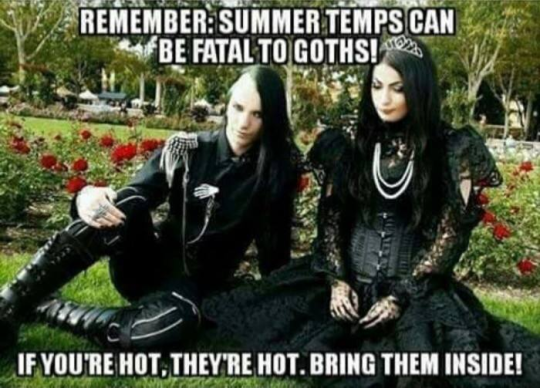
honestly if you want to take proper care of your goths you shouldn’t take them outside in hot weather at all, just winter and MAYBE late autumn/early spring if you live in a cool climate
people really should do this kind of research before getting goths at all but as long as they’re willing to learn and adapt i guess
there are breeds of goth suitable for warmer climes but you have to be very careful when looking for one and you cannot assume that your goth is one of them if you don’t know for sure what they are
even the warm-climate breeds still usually do better in their native locale’s winter temperatures though, and shouldn’t be left outside in the summer unattended or, at the bare minimum, they should be given plentiful shade, cold water, and appropriate music to keep them calm
Honestly, if you want something less fragile than a goth, you should be considering something like a punk anyway. There’s no need to expose goths to the heat, IMHO. Admittedly there’s differences you need to do research on, but punks are very rewarding. And for God’s sake, if anyone tells you ANY emo can handle the heat, run. They don’t know what the fuck they’re talking about.
goths aren’t fragile though? they’re not heat-tolerant but they’re extremely hardy in dark and stormy weather, metal concerts, and dramatic emotional episodes. just because they aren’t well-suited to one weather pattern doesn’t mean they can’t be extremely hardy and rewarding to keep under conditions they’re better suited to.
Forget the climate thing, there’s a more important husbandry issue here:
WHO THE FUCK PUT THEM OUT IN THE DAYTIME?
Direct sunlight is extremely harmful to goths! THey should never be outdoors before twilight!
Do your damn research, people.
you’re missing a key point though
goths need the opportunity to complain about sunlight, it’s vital to their wellbeing; as long as their time in it is carefully controlled and they’re given sufficient sunscreen and shade, it can be amazing and 100% necessary enrichment
Look at that picture. Look at it. Please tell me where the shade is, because I don’t see any. I see two goths wilting in direct sunlight. Just look at how flat their hair is! This is not even remotely acceptable care.
i never said the picture was a good example of goth husbandry, i think it’s sort of taken as a given that it’s not – nobody in this threat is endorsing it, op included
i’m just saying that it isn’t a black and white issue
Fair enough. I’ll concede that a properly-shaded porch or sunroom-type area can help them get the outdoor enrichment and complaining opportunities they need, without putting them at risk of direct sunlight or actually touching anything outdoors. But be careful not to overexpose them.
Aren’t there some varieties of goth that are built for sunlight, or is that me mistaking a similar species for goths?
You’re thinking of either New Romantics – unfortunately presumed extinct, you could tell them apart by their lack of Victorian plumage and occasional colouration – or Emos, which are the product of a crossbreeding with Shoegazers.
As mentioned above, emos don’t handle heat well, although they do better with moderate amounts of sun than purebred goths.
If it’s the ornate Victorian aesthetic you like but you want something that can keep up with a more active, diurnal lifestyle, you might consider a steampunk or steampunk cross? I know they’re somewhat out of fashion these days, but they can be just as endearingly dramatic as other goth breeds, and they thrive on daylight outings.










 Lady Karasu