Rita Skeeter: Hi- I’m doing a special tenth anniversary report on the battle of Hogwarts. Tell me, what do you think Harry Potter’s greatest achievement is- defeating he-who-must-not-be-named the first time, the second time, winning the triwizard tournament, slaying the basilisk?
Literally all of Harry’s classmates: There’s no need to call me sir, Professor.
fucked up how cooking and baking from scratch is viewed as a luxury…..like baking a loaf of bread or whatever is seen as something that only people with money/time can do. I’m not sure why capitalism decided to sell us the idea that we can’t make our own damn food bc it’s a special expensive thing that’s exclusive to wealthy retirees but it’s stupid as hell and it makes me angry
bread takes like max 4 ingredients counting water and sure it takes a couple hours but 80% of that is just waiting around while it does the thing and you can do other things while it’s rising/baking
plus im not gonna say baking cured my depression bc it didn’t but man is it hard to feel down when you’re eating slices of fresh bread you just made yourself. feels like everything’s gonna be a little more ok than you thought. it’s good.
bread is amazing and it’s also been sold to us as something really hard to make? Every time I tell someone I made a loaf of bread I get reactions like “you made it yourself???” and “do you have a bread machine then?” I haven’t touched a bread machine in probably 10 years. You CAN make your own bread, folks, and it’s actually pretty cheap to do so. I believe the most expensive thing I needed for it was the jar of yeast. It was about $6 at the grocery store and lasted me MONTHS (just keep it in the fridge.) The packets are even cheaper. destroy capitalism. bake your own bread.
You can also make your own yeast by making a sourdough starter, so that cuts cost even more.
But you have to feed the starter daily/weekly and that means it grows quickly, but there are tons of recipes online for what to do with your excess starter. Cookies, pretzels, crackers, pancakes, waffles, you name it!!
Make it even easier – “No-Knead Bread”. All YOU do is mix the ingredients together and wait until it’s time to heat the oven. The yeast does all the rest.
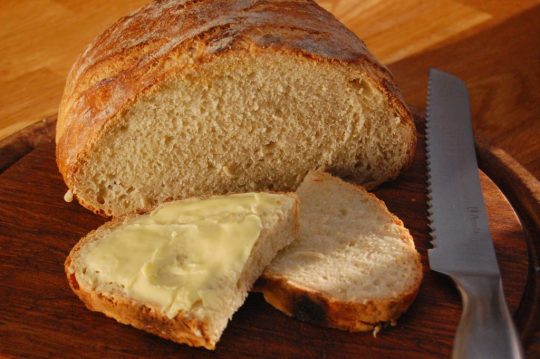
Here’s @dduane’s first take on itand the finished product. We’ve made even more photogenic batches since.
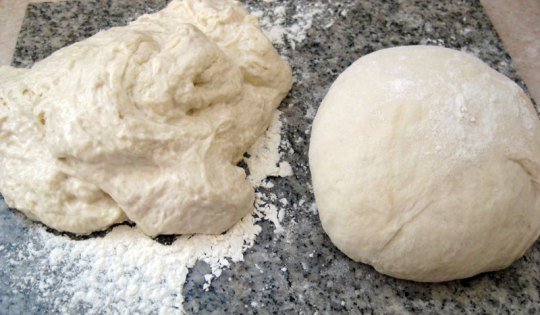
Kneading is easy as well; either let your machine do it, or if you don’t want to or don’t have one, get hands-on. It’s like mixing two colours of Plasticine to make a third. Flatten, stretch, fold, half-turn, repeat – it takes about 10 minutes – until the gloopy conglomeration of flour, yeast, salt and water that clings to your hands at the beginning, becomes a compact ball that doesn’t stick to things and feels silky-smooth.
Here’s what before and after look like.
My Mum used to say that if you were feeling out of sorts with someone, it was good to
make bread because you could transfer your annoyance into kneading the
dough REALLY WELL, and both you and the bread would be better for it.
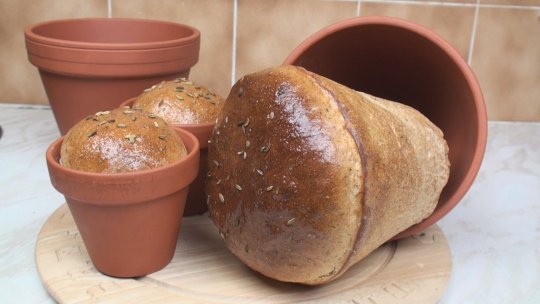
Then you put it into a bowl, cover it with cling-film and let it rise until it doubles in size, turn it out and “knock it back” (more kneading, until it’s getting back to the size it started, this means there won’t be huge “is something living in here?” holes in the bread), put it into your loaf-tin or whatever – we’ve used a regular oblong tin, a rectangular Pullman tin with a lid, a small glass casserole, an earthenware chicken roaster…
You can even use a clean terracotta flowerpot.
Let the dough rise again until it’s high enough to look like an unbaked but otherwise real loaf, then pop it in the preheated oven. On average we give ours 180°C / 355°F for 45-50 minutes. YM (and oven) MV.
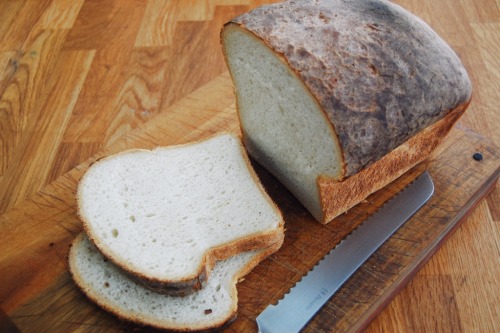
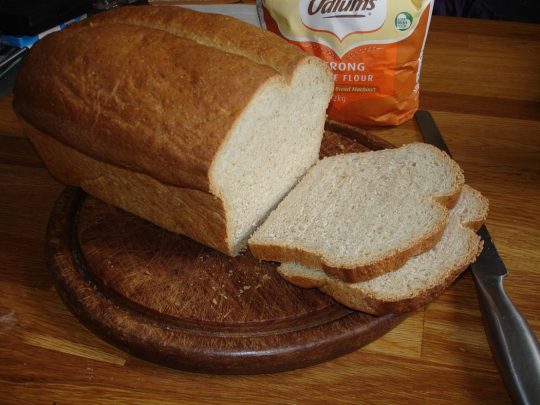
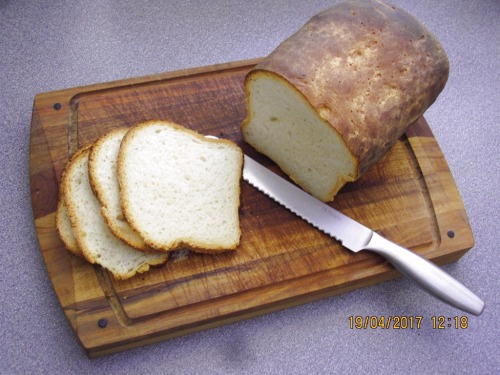
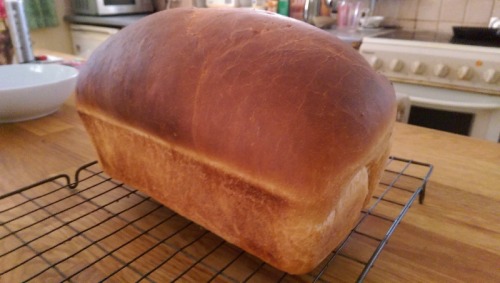
Here’s some of our bread…
Here’s our default bread recipe – it takes about 3-4 hours from flour jar to cutting board depending on climate (warmer is faster) most of which is rise time and baking; hands-on mixing, kneading and knocking-back is about 20 minutes, tops, and less if using a mixer.
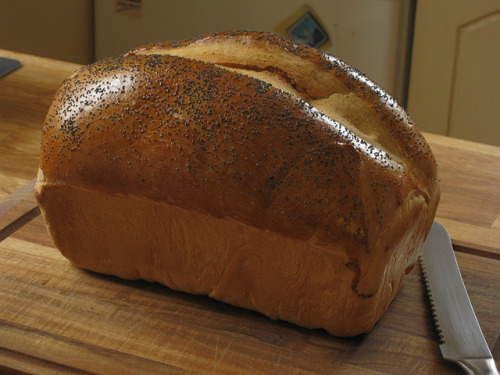
Here ( or indeed any of the other pics) is the finished product. This one was given an egg-wash to make it look glossy and keep the poppy-seeds in place; mostly we don’t bother with that or the slash down the middle, but all the extras were intentional as a “ready for my close-up” glamour shot.
I think any shop would be happy to have something this good-looking on their shelf.
We’re happy to have it on our table.
Even if your first attempts don’t work out quite as well as you hope, you can always make something like this…
can we have more posts like this in future please? this is really useful and could help those who are struggling
Signal boosting because you can bake your own bread and it’s awesome. I think people think it’s super complicated because yeast is just…weird…and also if you make the water too hot or too cold when you put the yeast in, it can fail to activate. Optimal water temp is between 105 and 110 degrees fahrenheit, or if you want to ballpark it, run the hot water tap in your kitchen sink until it feels hot and use that.
Anyway, fresh bread is fantastic and eating it makes people feel good. And yeah, unless you are trying to get fancy, it’s basically flour, water, yeast, and salt. Pizza dough is basically softer and more elastic bread and it’s the same ingredients plus olive oil. You can make pizza dough and then make your own pizza or calzones. I used to do that all the time and I’d still do it if it weren’t for the @$! insulin resistance.
Microbiologists and food-product developers have conducted laboratory experiments that involve challenging numerous foodborne bacteria, fungi, and yeasts with phytochemicals extracted from spice plants. Multiple techniques have been used to investigate inhibition, and the primary data vary considerably in quality and quantity for different spices. Nevertheless, it is now clear that many spices have potent antimicrobial properties
[…]
All 30 spices for which we located laboratory test results were found at some concentration to kill or inhibit at least 25% of the bacterial species on which they had been tested, and 15 of these spices inhibited at least 75% of bacterial species (Figure 4). Garlic, onion, allspice, and oregano were found to be the most potent spices: They inhibited or killed every bacterium they were tested on.
“
For example, India’s cuisine included 25 different spices, of which an average of 9.3 were called for per recipe, whereas Norwegian cuisine included only 10 different spices and called for an average of 1.6 per recipe. In Hungary, which has a temperate climate, the cuisine included 21 spices, of which an average of 3.0 were called for per recipe.
“
“As annual temperatures increased, the estimated fraction of food spoilage bacteria inhibited by the spices in each country’s recipes increased significantly. Therefore, the cuisine of hotter countries potentially has greater antibacterial activity.
Okay, it’s official. I’ve found my favourite historical anecdote of all time.
So in ancient Rome they had this tradition where they had to consult the gods and check they had divine approval before they went into battle. They did this by bringing forth a flock of sacred chickens and throwing grain at them. Their behaviour would then determine whether or not the gods were on your side. If the hens didn’t eat or wouldn’t leave their cage, it was a Bad Omen and you had to postpone battle and ask again the next day. If the chickens ate happily it was a Good Omen and you could go and chop up some Gauls or Carthaginians or whoever you happened to be fighting.
Now, there are lots of little stories about these chickens, but I just found one I hadn’t seen before. In 137 BC, the consul C. Hostilius Mancinus tried to take auspices before battle, but:
the chickens once released from their cage fled into a nearby wood and even though they were sought with the greatest diligence, they could not be recovered.
Can you fucking believe that. Can you actually believe that happened. The Romans have a reputation for being so stern and sensible and stoic and that happened. Like… everyone’s ready for battle, so you turn to your assistant and say “BRING FORTH THE CHICKENS” and you throw down the grain and open up their cage and the chickens just. run. they fucking run. those tiny velociraptor bastards abscond screaming into the woods like there’s no tomorrow. Blinking in disbelief, you send soldiers into the woods to recover them but those feathered bandits are gone. Vanished. The gods have deserted you. You’re beating bushes and following the sounds of triumphant clucks. The soldiers are frantic. The chickens are gone.
He lost the battle. It was a Bad Omen.
That sounds like the ultimate Bad Omen like at that point you go home and start drawing up an armistice bc the gods told you to go fuck yourself with chickens
That’s… pretty much what happened. The chicken omen, along with a few other Bad Omens, resulted in:
infelici pugna, turpi foedere, deditione funesta
“a lost battle, a shameful peace treaty, and a calamitous handover.”
so yeah, he lost the battle and had to go home and sign an embarrassing peace treaty that the Romans complained about years later, and when they talk about him they curse him for his praecipitem audaciam – “reckless audacity” – and vesana perseverantia “insane obstinacy” because NONE OF THIS WOULD HAVE HAPPENED IF YOU’D LISTENED TO THE CHICKENS AND POSTPONED BATTLE LIKE THEY TOLD YOU.
Don’t forget naval commander Claudius Pulcher, whose sacred chickens refused to eat anything before the battle of Drepana. He tossed the chickens overboard, saying if they won’t eat, then let them drink, and went into battle where he promptly lost almost all of his ships and crew. I forget if he died or returned to Rome in disgrace, but it was a freaking disaster and the sacred chickens called it.
I’m not sure which phrase in this post is my favorite, “bring forth the chickens” or “this would have never happened if you listened to the chickens.”
What about Pulcher’s line: “Bibant, quoniam esse nolunt!” – They can drink if they won’t eat! – after which the sacred chooks went swimming.
I bet the spreading news of what he’d done ruined the morale of his entire fleet and went a long way towards why he lost the battle. Men who think their commander has offended the gods aren’t going to fight well on his behalf, in case the gods spread their offended wrath around. (If I remember my “Myths of Ancient Greece and Rome” correctly, the Olympian lot tended to do that a lot.)
AFAIK when Pulcher* returned to Rome in disgrace the Senate immediately tried him for impiety (a Senatorial message to the gods that they didn’t approve of him either) then banished him to exile where he died soon after.
Moral: don’t be horrid to the holy hens.
(*For the second time in this post, spell-checker wanted me to spell his name as “Pucker”. Appropriate, I suppose. Go figure.)
Marvel doesn’t want to see this kid break his neck, so everyone from [the studio] was like, “Don’t! Don’t!” And Joe [Russo] just started salivating, “Just do it!” And he did it — and stuck it! Like… he bummed me out. – Chris Evans
















 Lady Karasu