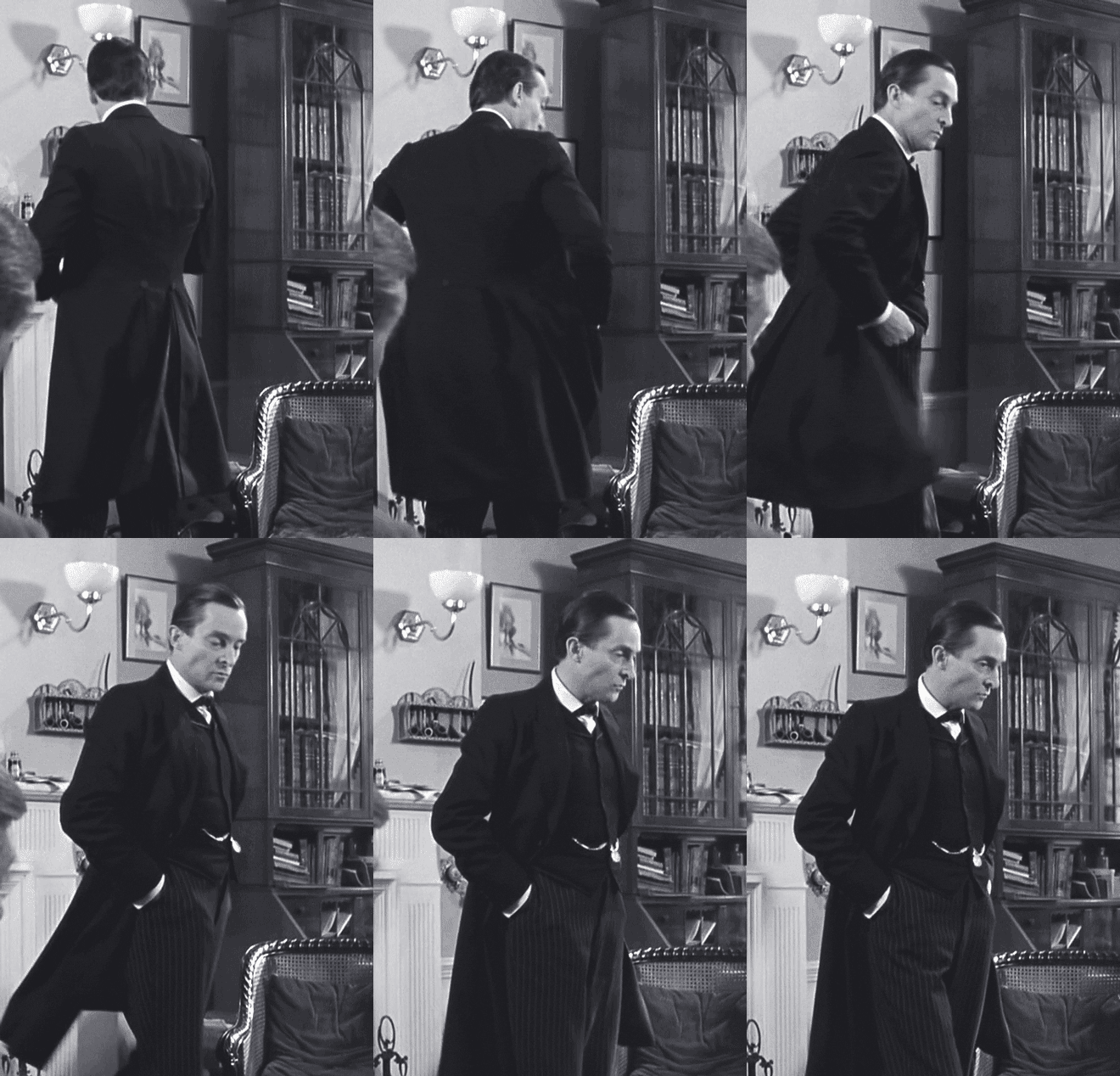
Watson: Holmes, that’s insane! *grabs overcoat* It is a dangerous plan and downright illegal! *puts on hat* I simply can’t let you go through with it! *opens front door*
This was so obvious when I realized it, but I think most people miss
it, because we’re so desensitized by D&D-style magic with immediate,
visibly, flashy effects, rather than more subtle and invisible forces
of magic. When Gollum attacks Frodo on the slopes of Mount Doom, Frodo
has the chance to kill him, but he doesn’t. Instead, he says:
Frodo: Go! And if you ever lay hands on me again, you yourself shall be cast into the Fire!
Frodo’s not just talking shit here. He is literally, magically laying a curse. He’s holding the One Ring in his hands as he says it;
even Sam, with no magic powers of his own, can sense that some powerful
mojo is being laid down. Frodo put a curse on Gollum: if you try to
take the Ring again, you’ll be cast into the Fire.
Five pages later, Gollum tries to take the Ring again. And that’s exactly what happens.
Frodo’s geas takes effect and Gollum eats lava.
On further reflection:
All the other people in the franchise who were offered the Ring declined to take it because they were wise enough to know that if they used its power – and the pressure to do so would be too great – they would be subject to its corruption.
Frodo uses the power of the Ring to lay a geas, and then five minutes later at the volcano’s edge, succumbs to its corruption. The Ring has gotten to him and he can no longer give it up. Because he used its power.
On further further reflection: I’d have to read the section again, but I recall that after throwing Gollum off and laying the geas, Sam observes that Frodo seems suddenly filled with energy again when previously he had been close to dead of fatigue. He hikes up the mountain so fast he leaves Sam behind – and doesn’t even seem to notice that he’s left him behind.
Could he have been drawing on the Ring’s power at this point in the story?
At this point in the story we’re relying on Sam’s narration, and Sam doesn’t know what’s going on in Frodo’s head, so it’s hard to say for sure.
Having used it once, after spending so long holding out against it, was that the breach in the dam?
Which means that the moment that Frodo succumbs to temptation is not the moment at the volcano – it was already too late by then. The moment he is taken by temptation was when he used the power of the Ring to repel Gollum.
If so, this ties in neatly with discussions I’ve seen about how Tolkien subscribes to a “not even once” view of good and evil – that in many other works it’s acceptable to do a small evil in service of a greater good, but in Lord of the Rings that always fails.
Re-reading Fellowship of the Rings, and I got to this passage in Lorien:
‘I would ask one thing before we go,’ said Frodo, ‘a thing which I often meant to ask Gandalf in Rivendell. I am permitted to wear the One Ring: why cannot I see all the others and know the thoughts of those that wear them?’
‘You have not tried,’ [Galadriel] said. ‘Only thrice have you set the Ring upon your finger since you knew what you possessed. Do not try! It would destroy you. Did not Gandalf tell you that the rings give power according to the measure of each possessor? Before you could use that power you would need to become stronger, and to train your will to the domination of others.’
In other words:
Frodo asks Galadriel, herself carrying a Ring of Power, “Could I, hypothetically, use the power of the One Ring to do something magical aside from turning invisible?” and Galadriel replies, “Yes, hypothetically, you totally could, assuming the magic you want to do involves laying compulsions on others, but I strongly recommend against it, because it would fuck up your brain.”
This was in the first book. At the end of the third book Frodo uses the Ring to fuck Gollum up, forcing him to throw himself into lava if he disobeys Frodo’s commands.
Talk about a chekov’s gun.
Got to this point in my re-read and uh. This was a lot less subtle than I remembered it.
‘Down, down!’ [Frodo] gasped, clutching his hand to his breast, so that beneath the cover of his leather shirt he clasped the Ring. ‘Down, you creeping thing, and out of my path! Your time is at an end. You cannot slay me or betray me now.’
Then suddenly, Sam saw these two rivals with other vision. A crouching shape, scarcely more than the shadow of a living thing, a creature now wholly ruined and defeated, yet filled with a hideous lust and rage; and before it stood stern, untouchable now by pity, a figure robed in white, but at its breast it held a wheel of fire. Out of the fire there spoke a commanding voice.
‘Begone, and trouble me no more! If you touch me ever again, you shall be cast yourself into the Fire of Doom.’
Then the vision passed and Sam saw Frodo standing, hand on breast, his breath coming in great gasps, and Gollum at his feet, resting on his knees with his wide-splayed hands upon the ground.
…
Yeah.
THIS IS GENIUS
This is excellent re-reading.
And all the way back in Rivendell, when Frodo wakes up after being rescued from the Nazgul, Pippin jokingly says something like “Make way for Frodo, Lord of the Ring!” and Gandalf says “Do. Not. Even, Joke. About that.”
I’d noticed the laying of the geas, but hadn’t figured out that the moment of temptation was then, not later at the Sammath Naur. This is a brilliant deduction which deserves publication in a Tolkien Studies journal, IMNSHO.
My ability to proofread increases by 1000% after I hit “Submit”.
this is often because when you’ve submitted something (like fanfiction to ao3) it will be in a different font, size and framing than in your word processor. The text will look different in the new environment so your brain stops skipping what looks familiar (like a typo that has been there since the beginning).
So, tip: revise your work in a different font and size. I guarantee you’ll catch more typos and mistakes than otherwise.
For all my writers (ones I follow and the ones that thankfully follow me)
I have asked this myself in the past and never gotten an answer.
Maybe today will be the day we are both finally enlightened.
woodsgotweird said: man i just jumped on the bandwagon because i am a sheep. i have no idea where it came from and i ask myself this question all the time
Maybe someone made a typo and it just got out of hand?
I kinda feel like panic!at the disco started the whole exclamation point thing and then it caught on around the internet, but maybe they got it from somewhere else, IDK.
The world may never know…
Maybe it’s something mathematical?
I’ve been in fandom since *about* when Panic! formed and the adjective!character thing was already going strong, pretty sure it predates them.
It’s a way of referring to particular variations of (usually) a character — dark!Will, junkie!Sherlock, et cetera. I have suspected for a while that it originated from some archive system that didn’t accommodate spaces in its tags, so to make common interpretations/versions of the characters searchable, people started jamming the words together with an infix.
(Lately I’ve seen people use the ! notation when the suffix isn’t the full name, but is actually the second part of a common fandom portmanteau. This bothers me a lot but it happens, so it’s worth being aware of.)
“Bang paths” (! is called a “bang"when not used for emphasis) were the first addressing scheme for email, before modern automatic routing was set up. If you wanted to write a mail to the Steve here in Engineering, you just wrote “Steve” in the to: field and the computer sent it to the local account named Steve. But if it was Steve over in the physics department you wrote it to phys!Steve; the computer sent it to the “phys” computer, which sent it in turn to the Steve account. To get Steve in the Art department over at NYU, you wrote NYU!art!Steve- your computer sends it to the NYU gateway computer sends it to the “art” computer sends it to the Steve account. Etc. (“Bang"s were just chosen because they were on the keyboard, not too visually noisy, and not used for a huge lot already).
It became pretty standard jargon, as I understand, to disambiguate when writing to other humans. First phys!Steve vs the Steve right next to you, just like you were taking to the machine, then getting looser (as jargon does) to reference, say, bearded!Steve vs bald!Steve.
So I’m guessing alternate character version tags probably came from that.
100% born of bang paths. fandom has be floating around on the internet for six seconds longer than there has been an internet so early users just used the jargon associated with the medium and since it’s a handy shorthand, we keep it.
Absolutely from the bang paths–saw people using them in early online fandom back in 1993 for referring to things.
I had been doing it for a very, very long time but never actually knew the actual name for it. This is exciting! I like learning things.
One of my favorite linguistic phenomena is rebracketing, which is when a word or words is/are redivided differently, either two words becoming one, one word heard as two, or part of one word interpreted as part of the other. This frequently happens with articles, for example:
apron was originally napron, but “a napron” was interpreted as “an apron”
newt comes from ewt by the same process
In the opposite direction, nickname comes from Middle English nekename which in turn came from ekename (an ekename -> a nekename) where “eke” was an old word meaning “also” or “additional” (so basically “an additional name”)
ammunition comes from an obsolete dialectal French amunition, which came from munition, the phrase la munition being heard as l’amunition.
the nickname Ned comes from Ed, via “mine Ed” being heard as “my Ned” (in archaic English, “my” and “mine” had the same relationship as “a” and “an”), same with several other nicknames like Nell
The word “orange” ulimately derives from the Arabic nāranj, via French “orange”, the n being lost via a similar process involving the indefinite article, e.g., something like French “une norange” becoming “une orange” (it’s unclear which specific Romance language it first happened in)
in the Southern US at least (not sure about elsewhere), “another” is often analyzed as “a nother”, hence the phrase “a whole nother”
omelet has a whole series of interesting changes; it comes from French omelette, earlier alemette (swapping around the /l/ and /m/), from alemelle from an earlier lemelle (la lemelle -> l’alemelle)
Related to this, sometimes two words, especially when borrowed into another language, will be taken as one. Numerous words were borrowed from Arabic with the definite article al- attached to them. Spanish el lagarto became English alligator. An interesting twist is admiral, earlier amiral (the d probably got in there from the influence of words like “administer”) from Arabic amir al- (lord of the ___), particularly the phrase amir al-bahr, literally “lord of the sea”.
Sometimes the opposite happens. A foreign word will look like two words, or like a word with an affix. For example, the Arabic kitaab (book) was borrowed into Swahili as kitabu. ki- happens to be the singular form of one of the Swahili genders, and so it was interpreted as ki-tabu. To form the plural of that gender, you replace ki- with vi-, thus, “books” in Swahili is vitabu. The Greek name Alexander became, in Arabic, Iskander, with the initial al- heard as the article al-.
Similarly, the English word Cherry came from Old Norman French cherise, with the s on the end interpreted as the plural -s. Interestingly enough, that word came from Vulgar Latin ceresia, a feminine singular noun, but originally the plural of the neuter noun ceresium! So a Latin plural was reinterpreted as a singular in Vulgar Latin, which in turn was interpreted as a plural when borrowed into English!
The English suffix -burger used with various foods (e.g., cheeseburger, or more informally chickenburger, etc.) was misanlyzed from Hamburger as Ham-burger, itself from the city of Hamburg
This can happen even with native words. Modern French once is used for the snow leopard, but originally meant “lynx”. In Old French, it was lonce (ultimately from the same source as lynx), which was reinterpreted as l’once! In English, the word “pea” was originally “pease”, but that looked like it had the plural -s on it, and so the word “pea” was created from it. Likewise, the adjective lone came from alone, heard as “a lone”, but alone itself came originally from all one.
One of my favorite personal examples is the old Southern man who would come into work and ask me if I was “being have” (as opposed to the more usual “behaving”).
the word editor predated the word edit – editor was reinterpreted as edit-er, so clearly someone who edits!
when your open borders advocacy extends to morpheme boundaries
Don’t forget the Swahili kipilefti (”roundabout”), from English keep left, with a plural vipilefti – and in reverse, singular kideo (”video”) with plural video.
Note that the “editor” > “edit-er” > “to edit” transformation is a related but distinct phenomenon called back-formation. That’s where you take a noun that sounds like it ought to be derived from a verb (though it really isn’t), and work backwards to obtain the “original” verb. Hence, we have it that editors edit, burglars burgle, and butlers buttle – though we haven’t yet gone so far as to suggest that fingers fing!



 Lady Karasu