Andrew Scott interview in today’s Times
Holmes’s nemesis Andrew Scott is now in an Irish comedy, as well as filming the latest Ken Loach and a new Frankenstein.
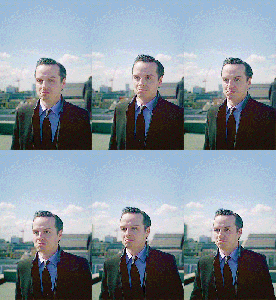
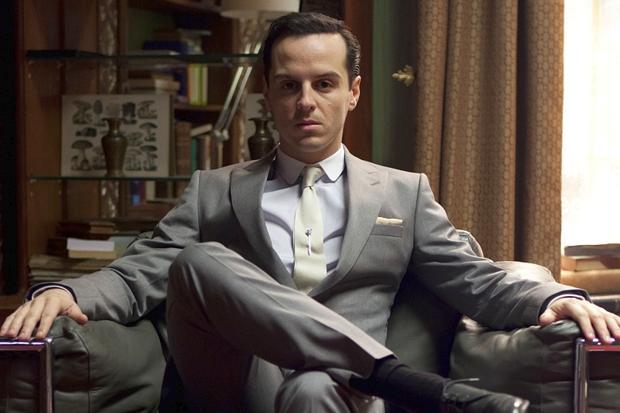
Fame, fame, fatal fame, to paraphrase a once-celebrated pop icon, it can really mess with your mind. And if your name happens to be award-winning 37-year-old theatre actor and overnight Sherlocksensation Andrew Scott, it can certainly shake up your daily routine, your professional schedule, and everything you know about yourself and your life. The Irish-born and London-based Scott is experiencing something close to a prolonged and hugely disorienting post-Sherlockian famegasm, where his celebrated and Bafta-winning turn as evil nemesis Jim Moriarty has thrown everything he knows into the air. Fans hound him. Studios want him. His private life is up for grabs. He’s made five films in the past year alone (include a new Ken Loach, a Tom Hardy movie and a reinvention of Frankenstein). While his next project, a play called Birdland, from Simon Stephens (who adapted The Curious Incident of the Dog in the Night-time for the National Theatre), is about a megastar who succumbs to the deleterious effects of, yep, fame.
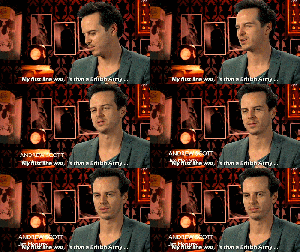
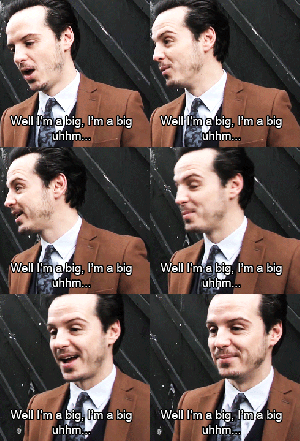
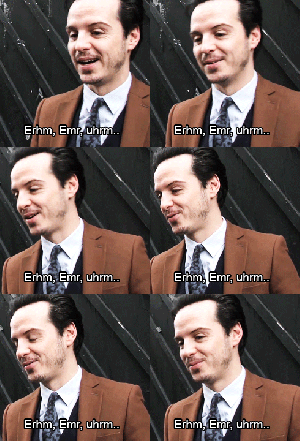
“I don’t want to overstate it,” he begins, cautiously, from a quiet concourse corner of the National Theatre (where he’s rehearsingBirdland, although it will play, eventually, in the Royal Court). “But my life is very different on a daily basis now.” He has arrived half-hidden behind a scarf and giant Ray-Bans, and throughout the interview is unfailingly polite, alternating between whip-smart self-deprecation and thoughtful, disquieted angst. “And although opportunities have come up in big, big, commercial projects, it’s not necessarily where I want to go, because I don’t want to compound the problem of being well-known. Why would I exacerbate that? I find it all a little bit stressful.” In what way? “Well, I don’t want people to become the enemy, but sometimes they’re just rude. I think it’s rude to go up and (lifts his phone off the table and sticks it into my face) and take a photograph of someone right in their face. Or when you’re on the Tube and someone takes out their phone and just starts recording you? It’s rude. And I always want to say, ‘If you just ask me I’ll do it, no problem!’ Because it’s nothing to do with being an actor, it’s just about what it means to be a human being.”
On top of which, Scott is an openly gay actor, but not open enough to enjoy chatting about his sexuality whenever he has a gig to plug. “There’s something a little bit oppressive about the idea that you have to speak about it every time you speak publicly,” he says, before noting that his line on the subject is that, “Being gay is not a virtue or a character flaw, just a fact. I’m absolutely comfortable with it, and I don’t want to be secretive, just private.”
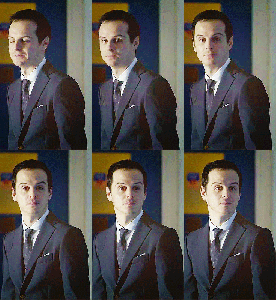
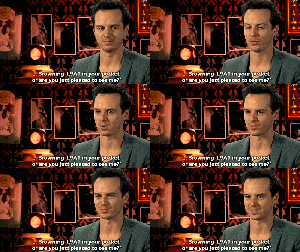
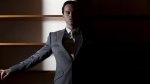
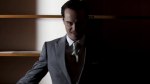
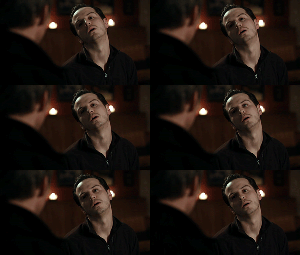
Of course, all this clamouring attention is understandable when you see Scott in action. He is possessed of the most idiosyncratic vocal cadence since early-era Christopher Walken, and his glassy-eyed delivery of Moriarty’s dialogue utterly defined the climactic, and the best, moments of two Sherlock seasons (“If you don’t stop prying,” begins his Moriarty, in normal voice, before suddenly shifting down to an insanely eerie whisper, “I will burn you!”). Of his Sherlockexperience he muses, “I knew it was a good script, and that it wasn’t a cynical exercise by any stretch of the imagination. But there was no way I could’ve predicted how big it would become.” He adds too, lest we get the wrong idea, that most Sherlock fans are charming, and that they frequently refer to him as “Mr Sex” (a Season Two in-joke). “Which,” he deadpans, “is better than being called Mr F***wit!”
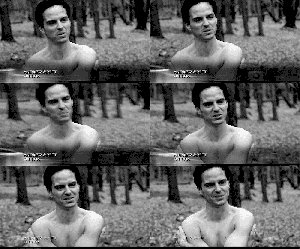
The trademark delivery is there too in the best moments of his latest project, a wedding-themed Hangover-style comedy of male bonding and mishaps set in the Irish wilderness and called The Stag. Here, as the Best Man hiding a guilty secret (he’s in love with the bride), he grounds the movie at every turn in aching, raging emotion, from an unexpectedly moving fireside rendition of the lost lovers’ ballad On Raglan Road to a desperate confession of inner torment that begins with (normal voice) “I was a mess, I was a pitiful mess” before diving into the depths of contorted agony with (nutty voice) “And my heart! My heart!” It’s real acting, in other words, and it protects the material against claims of whimsy, and elevates the movie to a place of both comedy and ideas (male identity, Irish provincialism, Recession-era realities) rather than just the former. Scott explains that he chose The Stag as a direct reaction to, yep, Sherlock. “I wanted to work on something a little closer to myself, a little more delicate, a proper human being. Sherlock has an incredibly wide reach, so I just wanted to have something out there that might restore the balance.”
It helps to better understand Scott, and his seeming aversion to the limelight, if you recognise that before Sherlock came calling he was already a successful stage actor, with multiple Olivier awards (including one for the Royal Court’s controversial 2004 kidnap drama A Girl in a Car With a Man) and annual nominations (including one for his 2006 Broadway debut, opposite Julianne Moore in the Sam Mendes-directed The Vertical Hour) over a 15-year career. “I was working all the time, I never had to borrow money, and I was happy with it,” he says. “The most successful actors are, to my mind, not the most famous or the richest. Being successful doesn’t mean being recognisable.”
His career had been forged in childhood, as a shy boy who found liberation only at weekend drama classes in suburban Dublin, where he grew up, with his two sisters (his younger sister, Hannah, is also an actress) and his parents, a mother who was an art teacher, a father who was an employment agency manager – both keen theatregoers. After a startling debut, aged 19, in the Irish father-son drama Korea, his screen work became fitful at best, first starring as Soldier on the Beach in Saving Private Ryan (“That consisted of Tom Hanks rolling over me, and me going, ‘Weeuuuughhhh!’”), and then picking up a supporting role in the TV epic Band of Brothers. The latter experience was something of a low point, which he remembers as a battle of egos and male primadonnas. “Damian Lewis was pleasant to me, and a lot of my scenes were with him,” he recalls. “But elsewhere it was just this atmosphere of everyone thinking that they were going to be massive movie stars and that, somehow, by not having trailers they were paying homage to the real soldiers of World War Two. All that posturing and strutting about wasn’t for me.” Notable roles followed: in the mini series John Adams, opposite Paul Giamatti; and as Paul McCartney in Lennon Naked (he’s devilishly good at accents too). Sherlock, though, was the game changer.
Scott lives in South London today. There are rumours of a long-term partner (he’d rather not comment). I wonder where does “coming out” now place him in the infamous stew of movie industry hypocrisy, where straight actors win awards for playing gay men (see this year’s Best Supporting Actor Oscar winner, Jared Leto) while gay actors find it hard, almost impossible, to find roles that allow them to play straight men (see, ahem, Zachary Quinto as Spock, but, well, does Spock even qualify as a man?). “Here’s what I think on that subject,” he says, with the tone of someone who’s thought about that subject a lot. “We don’t go to the cinema and think that Sandra Bullock and George Clooney are actually in space. Or that I’m arch enemies with Sherlock Holmes. The fun of film is in the suspension of disbelief. So it’s fun for a straight actor to play a gay guy, or a gay actor to play a straight guy. The only question then is about the proficiency of the actor playing the role. That is, unless you’re dealing with people who have a preconceived prejudice about those issues, and I’m not interested in trying to appease that audience.”
In the meantime, as well as Birdland, the new movie roles are coming in thick and fast — as a priest in Ken Loach’s period dramaJimmy’s Hall, and as a hapless builder haranguing Tom Hardy inLocke. And there’s a reunion of sorts with his Sherlock director Paul McGuigan, in a wild-sounding Frankenstein revamp, with James McAvoy as the mad scientist, Daniel Radcliffe as his faithful assistant Igor, and Scott himself starring as Frankenstein’s sparring partner, a “man of God” called Roderick Turpin. Of this busy professional slate he says, “My work is very much a part of who I am, and it feels very natural to me to be doing different genres, different roles, different accents. But my ultimate goal is to be happy.” And is he near that goal? “Yes, I am,” he says, instinctually, honestly, before suddenly catching himself and, wary of falling into the post-Sherlock fame trap adds, “But, really, that’s not for anyone else to worry about.”
The Stag is on general release
Interview with Kevin Maher

 Lady Karasu