okay but imagine harry potter as a long-running tv-show though.
tenish episodes per season, spread over an entire “school year”, for seven years.
they could actually give attention to side plots and they could flesh out things that aren’t explicit in the books and if they wanted to go crazy and do a 22-episode season they could really give a life to the books that they never got.
Tag: harry potter
can’t you imagine it though?
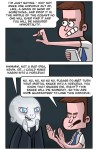
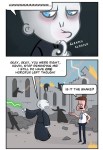
ginny’s going through a questioning phase and her older brothers keep making sex jokes so she writes in her diary “what’s a clitoris?” and tom’s on the other side like “i am a dark lord but i have a duty to this poor girl”
are you trying to insinuate that Voldemort gave Ginny Weasley the sex talk


“We’re in.”
{screeching}
Is it okay that I’m lost?
“Well it’s obvious you need my help, because you’ve actually found two.”
“No we haven’t.”
*stares at Harry* “Yes, you have.”
This. Is. Brilliant.
I don’t even care if this technically doesn’t fit the blog #yolo Potterlock 5ever this needs to be on our potterlock tag.


Harry Potter as a teen comedy.
Evidence that music placement is very important.
I swear I watch this every time it comes on my dash.
YES.

(Source: https://www.youtube.com/)
grantaire-put-that-bottle-down:
Harry Potter wizarding genetics decoded
If the wizarding gene is dominant, as J.K. Rowling says in her famous series of Harry Potter books, then how can a wizard be born to muggle parents (non-magical people)? And how can there be squibs (non-magical people born into wizarding lines)?
It seems these baffling genetic questions have finally been answered, thanks to Andrea Klenotiz, a biology student at the University of Delaware.
In a six-page paper, which she sent to Rowling, Klenotiz outlines how the wizarding gene works and even explains why some witches and wizards are more powerful than others.
“Magical ability could be explained by a single autosomal dominant gene if it is caused by an expansion of trinucleotide repeats with non-Mendelian ratios of inheritance,” Klenotiz explains.
What does this mean?
In school we learn the fundamentals of genetics by studying Gregory Mendel’s pea plant experiments and completing basic Punnett squares. Basically, we’re taught that whenever one copy of a gene linked to a dominant trait is present, then the offspring will exhibit that dominant trait, regardless of the other gene.
However, Non-Mendelian genes don’t follow this rule, which is the basis of Klenotiz’s argument. She says that the wizarding gene could be explained if it’s caused by a trinucleotide repeat, which is the repetition of three nucleotides — the building blocks of DNA — multiple times.
These repeats can be found in normal genes, but sometimes many more copies of this repeated code can appear in genes than is standard, causing a mutation. This kind of mutation is responsible for genetic diseases like Huntington’s Disease. Depending upon how many of these repeats occur in the genes, a person could exhibit no symptoms, could have a mild form of the disease or could have a severe form of it.
In her paper, Klenotiz argues that eggs with high levels of these repeats are more likely to be fertilized, a phenomenon known as transmission ratio distortion. She also suggests that the egg or sperm with high levels of repeats is less likely to be created or to survive in the wizarding womb.
This argument answers several questions about wizarding genetics:
How can a wizard be born to muggle parents?
Genetic mutations can randomly appear, meaning anyone could be born with the wizarding gene. However, there’s a better chance of magical offspring occurring if the parents are on the high side of the normal range for mutations.
How can a squib be born to wizard parents?
Although parents with these mutated magical genes would be likely to pass the gene on to their children, there’s still a possibility that any given offspring might not inherit the trinucleotide repeat.
How can varying degrees of magical ability be explained?
The more repeats a wizard inherits, the stronger the magical power he or she will have. If both wizarding parents are powerful wizards, it’s likely their offspring will also be powerful.
You can read Klenotiz’s full paper on wizarding genetics here.
Far and away one of the nerdiest things I’ve ever read. Love it.
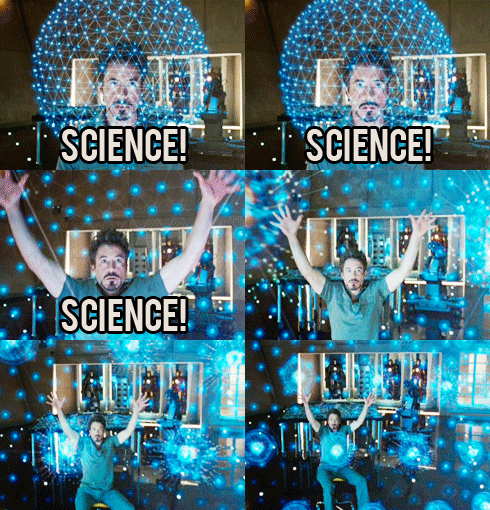
bringin it back
So this is like the trailer for Harry Potter if it were a movie that came out when I was in high school. It’s like “He’s All That.”
This was awesome.
Yep, this is how I remember that book. Exactly like this.
(Source: https://www.youtube.com/)
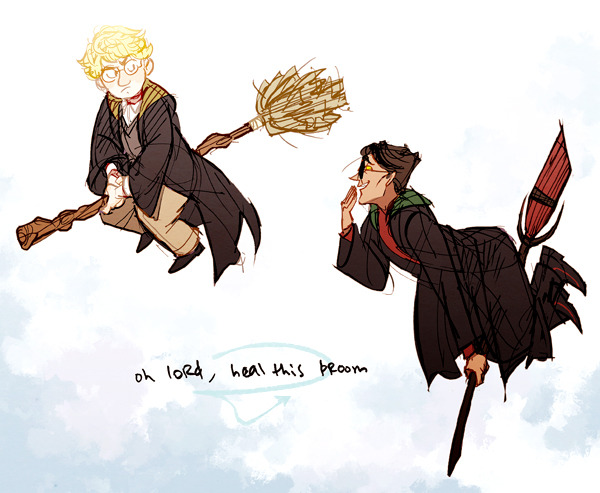
don’t think they’d care for quidditch, just hanging out in the sky nbd
also i’m not gonna lie i do personally think crowley is more of a gryffindor but


it kind of bothers me that after all this time people still dont understand how sorting works in harry potter
its not necessarily based on the characteristics you possess, its the ones you value, and that my friends is completely different. that is why the sorting hat considers your choice, otherwise why would he bother with your opinion
primary examples would be hermione, wormtail and lockhart
 Lady Karasu