Why Mary Stands There
In the Baker St confrontation Mary immediately goes to stand next to the mantel. Why? Because there’s an open knife there. She is ready for a fight and is not just armed with a gun but is also aware of this other weapon in the flat. By standing to the left of the knife, she can easily grab it with her right hand and she can also prevent John and Sherlock from grabbing it to use against her.
Things that occur earlier in this episode enforce this idea. Bill pulls a knife on John and John takes it from him, even asking if the knife is, ‘a clue’. Here, with Mary, it most certainly is,
Only slightly earlier we get the idea of making do with whatever weapon you can find, here,
(*cough* pay no attention to the fact that Mary seems to be mocking his wang, here…)
Then, at Baker St, itself, we will have Magnussen’s henchman reveal that John has multiple weapons,
(*ahem* pay no attention to the fact that Sherlock looks impressed as crap by John’s, ‘wang’, here, in stark contrast to Mary’s reaction…)
And soon after, Sherlock will mock him for it,
Except, there’s a clause,
Now, that we know, ‘how the night’, went, we must wonder, is John armed during the Baker St confrontation?
In this nifty visual, we see Mary in relation to the knife and to John: she is a threat to him, but she’s looking away. Maybe she doesn’t want to have to hurt him?
Ditto, here, with Sherlock, except she looks right at him in a penetrating way. Maybe Sherlock she doesn’t mind hurting so much. I mean, she did just shoot him,
With bonus: as Sherlock sits down, we see a sliver of Mary’s arm and the knife is seen as being right in his back. She stabbed him in the back once and she would/will do it again,
Now, for poetic flare, let us harken to the sweet, sweet past of ASiP and see that this is a knife that Sherlock put here, on the mantel, the first time John walked into Baker St,
This is the knife he puts there because he’s, ‘straightening up’, for John. He is trying to make his flat more appealing while also using a suggestive idiom for cleaning up. Sherlock will do whatever it takes to have John in his life, including hiding his feelings and appearing straight.
This is the same knife that Mary will put in his back. She is using his love of John against him. She knows that he has a blindspot for her because he loves John and she has, up to this point, exploited this to her advantage, nearly killing him.
Tag: Photoset Philosophy


The whole of Sherlock Series 3 in one frame:
That’s it. That’s the show.
You’re probably think I’m being facetious and silly, but nope. I’m not one to talk about cinematography and lighting, but I like talking about stories, so I’m going to tell you one.
Series 3 of Sherlock is based pretty heavily on Through the Looking Glass—there are an inordinate number of parallels and references, and in a lot of ways, it’s the story that they were telling this series. While writing about that, one quote in particular jumped out at me. It’s about the Red Queen’s Race.
“Well, in our country,” said Alice, still panting a little, “you’d generally get to somewhere else — if you run very fast for a long time, as we’ve been doing.”
“A slow sort of country!” said the Queen. “If you want to get somewhere else, you must run at least twice as fast as that!”From the moment Sherlock returns, he finds himself fighting to maintain his place. He fell through the looking glass, and expected to find that his world was the same, but it isn’t. Everything is different. He spends most of The Empty Hearse fighting to return his friendship with John to anything resembling what it was before he faked his death. He spends most of The Sign of Three doing everything can do for John. He helps plan the rehearsal, the wedding, and the reception. He plans a stag night and gives a a speech, and all of it is clearly about as far from his comfort zone as it possible for him to be. Before the fall, all of that effort probably would have deepened his relationship with John (however you view it), but here, it barely helps him maintain his place in John’s life.
“I’ve never made a vow in my life, and after tonight I never will again. So, here in front of you all, my first and last vow. Mary and John: whatever it takes, whatever happens, from now on I swear I will always be there, always, for all three of you.”
In the end, it’s not even enough to do that. It’s not enough for any of them.
Think about Sherlock, John, and Mary in His Last Vow. They’re not getting anywhere—they’re all trying desperately to maintain the place that they’re in, so they don’t send their whole house of cards tumbling down. Sherlock tries to push John and Mary back together even though Mary shot him. Mary doesn’t face up to her culpability and refuses to acknowledge that her past isn’t really behind her at all. John takes her back, though he refuses to know anything about her past. They’re all absurd decisions in our world—but we’re through the looking glass. It’s all they can do.
Here, you see, it takes all the running you can do, to keep in the same place.
How do you show us that visually? How do you tell us it’s the story you’re telling? You put the Red Queen of the story on a treadmill.
(shameless plug: I’m starting at tumblr dedicated to story references in Sherlock.)



Part one of two (part two)
This right here is why Sherlock the series is different from other “tortured hero” works, particularly American ones (looking at you, Elementary and House, though I did love a good chunk of the latter’s run). Sherlock is not going to be “fixed.” The show doesn’t believe Sherlock needs to be fixed.
Does he need to be more aware of others’ feelings? Sure.
Does he need loved ones in his life to care about, and to care about him? Yes.
Does he need to show appreciation to said loved ones? Absolutely.
But he does he need to change who he is? No.
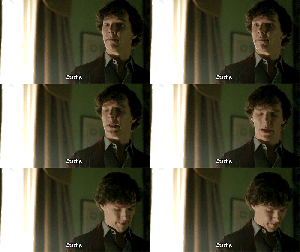
Other characters think he’s weird, and the show says, “Yeah, he is. And?”
No one, not even his best friend, knows his sexual orientation. The show says, “So what?”
He’s a virgin. The show says, “He doesn’t want to have sex. Who cares?”
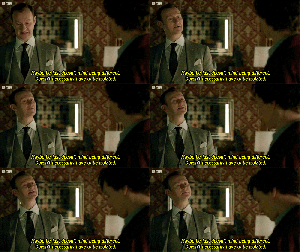
The whole point of this scene between Sherlock and Mycroft is that being different isn’t bad, but isolating yourself is. Both Sherlock and Mycroft are strange ducks, but whereas Mycroft is lonely because he wants to put himself above it all, Sherlock is not. Sherlock realizes that being lonely doesn’t make you special, the beauty of life is in finding those people who will love and appreciate you as that strange duck you are. Sherlock is needling Mycroft in this scene because he wants that for his brother.
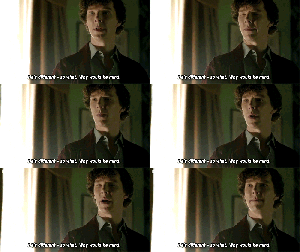
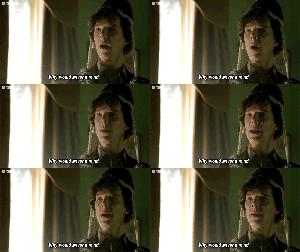
“He’s different – so what. Why would he mind. Why would anyone mind?”
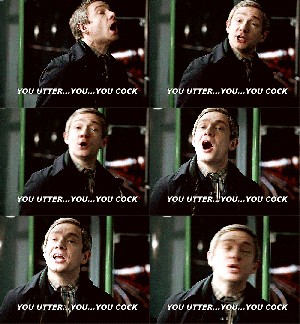
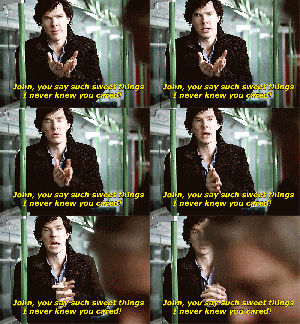
sarcastic sherlock is my sexuality
Here, this is why this scene worked for me. Look at John. He is not actually angry. He is almost laughing. I can almost HEAR his internal monologue: “oh thank God we’re not going to die that is awesome and also I don’t have to sit here and think about all the emotion I just horked all over Sherlock or even look him in the eye and acknowledge it because he fucking tricked me and now I can call him a cock, which he is, and he can be sarcastic at me and whew that was a close one but we can go back to our normal relationship but I got to say that thing and he got to say that thing and it was real but we get to pretend it didn’t happen because we’re emotionally constipated so we can laugh it off but we know that we love each other in that way that makes us punch each other and thank God for that and he is still a cock, but he is MY cock and oh my that sounded iffy, didn’t it?”


“Actually, do you know what, ignore me.”
John. John Watson. He just killed a man to save me from myself. Who does that? God.
Look at him: he’s not like an ordinary man. He just shot someone and he’s perfectly fine. Not a hair out of place. He’s just standing there with those nerves of steel, those steady hands, he’s playing innocent, standing on the other side of the tape like he’s uninvolved. He thinks I won’t figure it out, he thinks I won’t know. He’s not ashamed of it or proud of himself; he just did what he thought was right. He didn’t even do it to impress me; he’s not trying to make a point, he’s not demonstrating his usefulness to me. He’s not going to hold it over my head, either. Is he. He found his way here just to protect me. Gratis. As if that’s completely natural.
Natural for him, maybe. Yes. Completely natural for him. My hidden jewel: John Watson. How could I have been so blind?
I would be dead by now without him. I chose the wrong pill. I was wrong twice tonight. A true failure of an evening, by all accounts: two massive failures of observation, more if you count the details. It doesn’t matter: we’re both still here. Second chance: I’m paying attention to you now, John Watson. I see it all in you now.
He came after me, even after I told him I was married to my work. Even after I left him and ran off on my own, twice. I wonder if there’s a way to revisit that conversation, hmm. Not really an area in which I have any real expertise. Is that what he wants? How does one go about doing that?
I thought he was ordinary. I didn’t know what I was dealing with. Unfair! He was hiding in plain sight. He thinks of himself as ordinary, so he appears to be ordinary. To the naked eye, at least. But he’s not. Most definitely not. His hands aren’t even shaking, not even now. Look at that.
Oh, I’m keeping him.
Perfect.
Perfect squared.




The first time you see it, it can hit you really hard, especially since Sherlock is on a total roll and John delivers the line “please God, let me live” in a way where you can be forgiven for not being sure if it’s serious or snark. It apparently has the same effect on Sherlock, as well.
We never do get any details on how Captain John Watson of the Fifth Northumberland Fusiliers was wounded in action. But from this exchange alone, it’s clear the situation was extremely serious. He was badly wounded, nearly died, and developed PTSD- Sherlock had himself earlier pointed out that the original circumstances of John’s injury must have been ‘traumatic’, and he meant emotionally traumatic, not just violent and painful. The blunt earnestness of John’s response even trips up Sherlock for a second or two, and he’s just been ranting and raving about not understanding why a woman would care about her stillborn baby after fourteen years. This also works as a tearjerker in hindsight if you recall ‘Please God, let me live’ whenever John is genuinely in physical danger elsewhere in the series.
Pretty much everyone in the room agrees that in your last moments, you would think about the people you love the most. John apparently had no one to think about when he was close to dying. He really must have been lonely even before he returned from Afghanistan.
I hate you for making this post because it’s the best I’ve read on this subject and it hurts.


“At Sherlock’s grave, before finally walking away, John’s quick-turn is how a lower ranking officer would leave the presence of a higher one after being dismissed. The whole time, consciously or unconsciously, John has viewed Sherlock as his superior officer, someone he needs to trust and take orders from in order to make their friendship/crime solving work.” (x)
And that little nod he gives… its the kind a lower ranking officer would give when being dismissed. Its either a ‘Yes, sir.’ or a short nod. And so he’s being dismissed. He’s being dismissed from whatever life he had before Sherlock died.
I don’t think John’s behaviour at Sherlock’s grave is indicative of him feeling that he’s literally outranked in their relationship. I don’t think John saw Sherlock as his superior officer in any way. Sherlock and John are (or, at this point, were) friends, they complement each other in very specific and I would argue entirely equal ways. What they have is a perfectly balanced, mutually beneficial partnership.
John might not be the genius Sherlock is, but he is an equal contributor in the context of their lives together, and he knows that he is. They are mutually invested in solving crimes. Granted, it’s easier to see that John is also invested in Sherlock himself, but I think the reverse is true as well. John is Sherlock’s emotional centre, his moral and ethical barometer, and his muse. I think it’s a mistake to see John as merely an assistant in any context. John does not merely take orders from Sherlock, and Sherlock frequently take orders from John when he’s at a loss. Sherlock has his expertise and John respects that; John also has his, and Sherlock will do what John tells him to do, even if he doesn’t entirely understand why.
Sherlock needs John as much as John needs Sherlock. They take care of each other in exactly the way each of them needs taking care of. They are in perfect balance, their own private harmony. That’s why no one else can come between them. Not girlfriends, not family, not holidays: nothing. They are two halves, and are entirely complete together.
My interpretation of John’s behaviour at Sherlock’s grave is this: he’s using the most meaningful actions he can to demonstrate his utmost and unfailing respect for someone who is not a fake, is not a fraud, and did not do the things he is being accused of. He’s saying goodbye to someone who deserves a flypast and a twenty-one gun salute.


I’m sure that Mrs. Hudson’s husband committed a great number of crimes in order to get sentenced to death. From the way she flinches when Sherlock slams his hands on the table, I’d say it’s safe to bet that one of his many crimes was spousal abuse.
That would certainly account for why Sherlock ensured his execution.
And why Sherlock got so enraged when he saw that she had been hurt
#is this or is this not seb moran #in the perfect suit jim bought him because ‘i know public school taught you how to dress darling’ #a tie pin because you don’t want a two hundred pound tie to get in the way when you’re trying to knife a bastard #leather gloves because evidence? what evidence #and because jim likes how they feel around his neck #but seb doesn’t like admitting to that #and you just know that cigarette case is engraved #’cry havoc and let slip the dogs of war’ #there’s still a bit of scruff on his face though #because you can take the game hunter out of the… well you know the rest #he’s got to go anyway #there’s some fucking uppity russians to kill #and jim’s laughing in his earpiece because he knows exactly what seb’s going to do with that tie later #god i ship the fuck out of these nasty bastards
- john watson is not helpless
- john watson can take care of himself, thank you very much
- john watson is a soldier, a fighter, and a very intelligent man
- john watson is far more than just capable, and sherlock holmes knows this better than anyone.
Sherlock’s very proud of ” his ” John
 Lady Karasu