Ahhh! This is so cool!
An author was writing historical fiction, and decided (in hopes of escaping anachronistic language) to only use the vocabulary that Jane Austen used. They made a custom dictionary of all the words Jane Austen used in all of her books, and used that to spell check, so it flagged modern words and phrases that she would have totally overlooked otherwise.
I’m thinking it would be incredibly easy to do the same thing for fanfiction, especially book-based – compile a dictionary of, say, all the words GRRM used in ASOIAF, and use that as a spell check dictionary so it would flag any words GRRM did not use…
Or a particular TV show character’s dialogue, though that would involve much more manual effort…
edit: apparently, some historical fiction authors use old dictionaries (circa: 1700-1800s) as their custom dictionaries, even when writing about much earlier time periods. This helps them escape writing with modern-sounding anachronisms that throw modern readers out of the story, but also allows them to use language that a modern reader can understand when writing about time periods where characters should be speaking, say, Old English.
friendly reminder that such a thing has been developed for the les mis fandom
These are some great resources for authors of historical fiction (and/or fan fiction)!
Man, and I’ve just been doing this manually and relying on assistance from betas for my Regency stuff…
Tag: reference
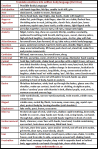
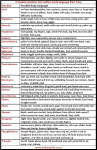
Cheat Sheets for Writing Body Language
We are always told to use body language in our writing. Sometimes, it’s easier said than written. I decided to create these cheat sheets to help you show a character’s state of mind. Obviously, a character may exhibit a number of these behaviours. For example, he may be shocked and angry, or shocked and happy. Use these combinations as needed.

How to Edit Your Own Writing
Like most newspaper reporters, I got into the biz because a) I love writing and b) I’m pretty good at it. But it’s a sobering profession. You file your masterpiece, only to find your editor thinks it’s two dozen “tinks” shy of publishable. Repeat this scenario a couple hundred times, and you’ll find you’ve grown some thick skin. You’ve also gotten pretty darn good at self-editing. So, I’m here to impart some wisdom on the art of quickly perfecting your own workâhow to hone, trim, and morph clumsy words and phrases into a clear, concise message that will wow your audience.Check out Caroline McMillan’s Life Hacker article on editing your own writing, it contains some great tips.
site that you can type in the definition of a word and get the word
site for when you can only remember part of a word/its definition
THAT FIRST SITE IS EVERY WRITER’S DREAM DO YOU KNOW HOW MANY TIMES I’VE TRIED WRITING SOMETHING AND THOUGHT GOD DAMN IS THERE A SPECIFIC WORD FOR WHAT I’M USING TWO SENTENCES TO DESCRIBE AND JUST GETTING A BUNCH OF SHIT GOOGLE RESULTS
42 Flowers You Can Eat
by Melissa Breyer Living / Green Food
The culinary use of flowers dates back thousands of years to the Chinese, Greek and Romans. Many cultures use flowers in their traditional cooking — think of squash blossoms in Italian food and rose petals in Indian food. Adding flowers to your food can be a nice way to add color, flavor and a little whimsy. Some are spicy, and some herbacious, while others are floral and fragrant. The range is surprising.
It’s not uncommon to see flower petals used in salads, teas, and as garnish for desserts, but they inspire creative uses as well — roll spicy ones (like chive blossoms) into handmade pasta dough, incorporate floral ones into homemade ice cream, pickle flower buds (like nasturtium) to make ersatz capers, use them to make a floral simple syrup for use in lemonade or cocktails. I once stuffed gladiolus following a recipe for stuffed squash blossoms — they were great. So many possibilities…
Eating Flowers Safely
So. As lovely as eating flowers can be, it can also be a little … deadly! Not to scare you off or anything. Follow these tips for eating flowers safely:
- Eat flowers you know to be consumable — if you are uncertain, consult a reference book on edible flowers and plants.
- Eat flowers you have grown yourself, or know to be safe for consumption. Flowers from the florist or nursery have probably been treated with pesticides or other chemicals.
- Do not eat roadside flowers or those picked in public parks. Both may have been treated with pesticide or herbicide, and roadside flowers may be polluted by car exhaust.
- Eat only the petals, and remove pistils and stamens before eating.
- If you suffer from allergies, introduce edible flowers gradually, as they may exacerbate allergies.
- To keep flowers fresh, place them on moist paper towels and refrigerate in an airtight container. Some will last up to 10 days this way. Ice water can revitalize limp flowers.
Allium to Violets
1. Allium
All blossoms from the allium family (leeks, chives, garlic, garlic chives) are edible and flavorful! Flavors run the gamut from delicate leek to robust garlic. Every part of these plants is edible.2. Angelica
Depending on the variety, flowers range from pale lavender-blue to deep rose and have a licorice-like flavor.3. Anise hyssop
Both flowers and leaves have a subtle anise or licorice flavor.4. Arugula
Blossoms are small with dark centers and with a peppery flavor much like the leaves. They range in color from white to yellow with dark purple streaks.5. Bachelor’s button
Grassy in flavor, the petals are edible. Avoid the bitter calyx.6. Basil
Blossoms come in a variety of colors, from white to pink to lavender; flavor is similar to the leaves, but milder.7. Bee balm
The red flowers have a minty flavor.8. Borage
Blossoms are a lovely blue hue and taste like cucumber!9. Calendula / marigold
A great flower for eating, calendula blossoms are peppery, tangy, and spicy — and their vibrant golden color adds dash to any dish.10. Carnations / dianthus
Petals are sweet, once trimmed away from the base. The blossoms taste like their sweet, perfumed aroma.11. Chamomile
Small and daisylike, the flowers have a sweet flavor and are often used in tea. Ragweed sufferers may be allergic to chamomile.12. Chervil
Delicate blossoms and flavor, which is anise-tinged.13. Chicory
Mildly bitter earthiness of chicory is evident in the petals and buds, which can be pickled.14. Chrysanthemum
A little bitter, mums come in a rainbow of colors and a range of flavors range from peppery to pungent. Use only the petals.15. Cilantro
Like the leaves, people either love the blossoms or hate them. The flowers share the grassy flavor of the herb. Use them fresh as they lose their charm when heated.16. Citrus (orange, lemon, lime, grapefruit, kumquat)
Citrus blossoms are sweet and highly scented. Use frugally or they will over-perfume a dish.17. Clover
Flowers are sweet with a hint of licorice.18. Dandelion
Read more about dandelions here: Backyard Forage for Dandelions.19. Dill
Yellow dill flowers taste much like the herb’s leaves.20. English daisy
These aren’t the best-tasting petals — they are somewhat bitter — but they look great!21. Fennel
Yellow fennel flowers are eye candy with a subtle licorice flavor, much like the herb itself.22. Fuchsia
Tangy fuchsia flowers make a beautiful garnish.23. Gladiolus
Who knew? Although gladioli are bland, they can be stuffed, or their petals removed for an interesting salad garnish.24. Hibiscus
Famously used in hibiscus tea, the vibrant cranberry flavor is tart and can be used sparingly.25. Hollyhock
Bland and vegetal in flavor, hollyhock blossoms make a showy, edible garnish.26. Impatiens
Flowers don’t have much flavor — best as a pretty garnish or for candying.27. Jasmine
These super-fragrant blooms are used in tea; you can also use them in sweet dishes, but sparingly.28. Johnny Jump-Up
Adorable and delicious, the flowers have a subtle mint flavor great for salads, pastas, fruit dishes and drinks.29. Lavender
Sweet, spicy, and perfumed, the flowers are a great addition to both savory and sweet dishes.30. Lemon berbena
The diminutive off-white blossoms are redolent of lemon — and great for teas and desserts.31. Lilac
The blooms are pungent, but the floral citrusy aroma translates to its flavor as well.32. Mint
The flowers are — surprise! — minty. Their intensity varies among varieties.33. Nasturtium
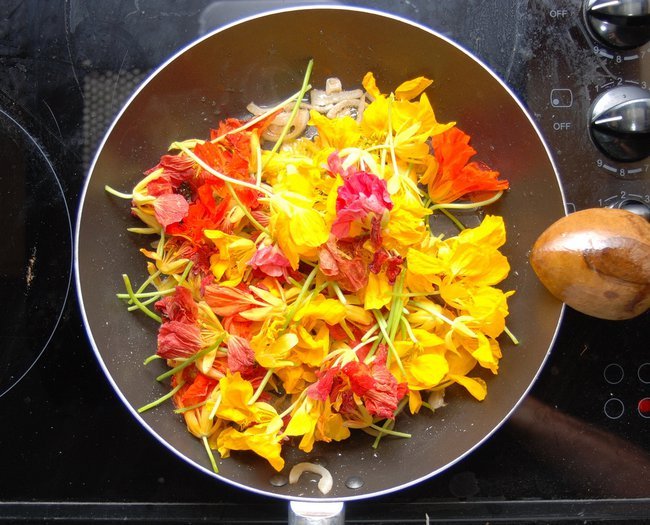
One of the most popular edible flowers, nasturtium blossoms are brilliantly colored with a sweet, floral flavor bursting with a spicy pepper finish. When the flowers go to seed, the seed pod is a marvel of sweet and spicy. You can stuff flowers, add leaves to salads, pickle buds like capers, and garnish to your heart’s content.34. Oregano
The flowers are a pretty, subtle version of the leaf.35. Pansy
The petals are somewhat nondescript, but if you eat the whole flower you get more taste.36. Radish
Varying in color, radish flowers have a distinctive, peppery bite.37. Rose
Remove the white, bitter base and the remaining petals have a strongly perfumed flavor perfect for floating in drinks or scattering across desserts, and for a variety of jams. All roses are edible, with flavor more pronounced in darker varieties.38. Rosemary
Flowers taste like a milder version of the herb; nice used as a garnish on dishes that incorporate rosemary.39. Sage
Blossoms have a subtle flavor similar to the leaves.40. Squash and pumpkin
Blossoms from both are wonderful vehicles for stuffing, each having a slight squash flavor. Remove stamens before using.41. Sunflower
Petals can be eaten, and the bud can be steamed like an artichoke.42. Violets
Another famous edible flower, violets are floral, sweet and beautiful as garnishes. Use the flowers in salads and to garnish desserts and drinks.From True Food: Eight Simple Steps to a Healthier You (National Geographic, 2009) by Annie B. Bond, Melissa Breyer and Wendy Gordon.
/|
☽✪☾
The Dance at Alder Cove – Youth/Father/Geezer – I see you//

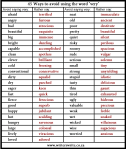
“Oh captain, my captain.”
yesss…
DPS and a list of beautiful words? Oh yes.
Love.
You’re welcome
This is the most useful thing I’ve ever reblogged.
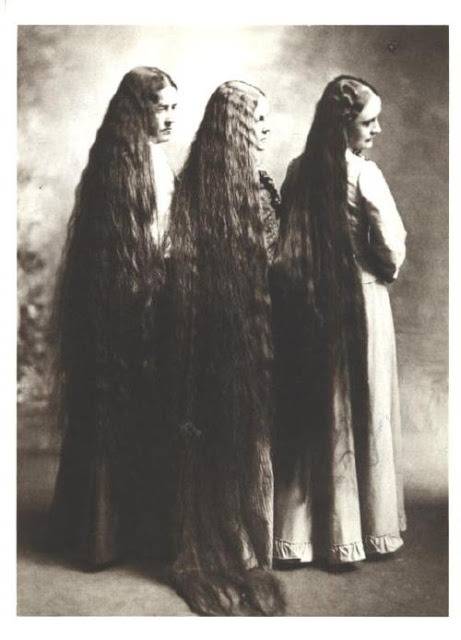
Historical women kept their hair clean, but that doesn’t mean their hair was often directly washed. Those who had incredibly difficult to manage hair might employ a hairdresser to help them wash, cut, and singe (yes, singe!) their hair as often as once a month, but for most women, hair-washing was, at most, a seasonal activity.
“Why?” you might ask. “Wasn’t their hair lank, smelly, and nasty?”
And the writers who embrace ignorance as a badge of honor will say, “Well, that just goes to show that people used to be gross and dirty, and that’s why I never bother with that historical accuracy stuff!”
And then I have to restrain myself from hitting them…
The reason that hair was rarely washed has to do with the nature of soaps versus modern shampoos. Soaps are made from a lye base and are alkaline. Hair and shampoo are acidic. Washing hair in soap makes it very dry, brittle, and tangly. Men’s hair was shirt enough and cut often enough that using soap didn’t harm it too much and the natural oils from the scalp could re-moisturize it fairly easily after even the harshest treatment, but in an age when the average woman’s hair was down to her waist, soap could literally destroy a woman’s head of hair in fairly short order.
Instead, indirect methods of hair-cleaning were used. Women washed their hair brushes daily, and the proverbial “100 strokes” were used to spread conditioning oils from roots to tips and to remove older or excess oil and dirt. This was more time-consuming than modern washing, and this is one of the reasons that “good hair” was a class marker. The fact that only women of the upper classes could afford all the various rats, rolls, and other fake additions to bulk out their real hair was another. (An average Victorian woman of the upper middle or upper class had more apparent “hair” in her hairstyle than women I know whose unbound hair falls well below their knees.) Women rarely wore their hair lose unless it was in the process of being put up or taken down–or unless they were having a picture specifically taken of it! At night, most women braided their hair for bed. Now that my hair is well below my waist, I understand why!
The first modern shampoo was introduced in the late 1920s. Shampoos clean hair quickly and also remove modern styling products, like hairspray and gel, but the frequent hair-washing that has become common leaves longer hair brittle even with the best modern formulations. (From the 1940s to the 1960s, many if not most middle-class women had their hair washed only once a week, at their hairdresser’s, where it was restyled for the next week. The professional hairdresser stepped into the void that the maid left when domestic service became rare. Washing one’s hair daily or every other day is a very recent development.) That’s where conditioners came into play. Many people have wondered how on earth women could have nice hair by modern standards before conditioners, but conditioners are made necessary by shampoos. Well-maintained hair of the 19th century didn’t need conditioners because the oils weren’t regularly stripped from it.
Additionally, the oils made hair much more manageable than most people’s is today, which made it possible for women to obtain elaborate hairstyles using combs and pins–without modern clips or sprays–to keep their hair in place. This is why hair dressers still like to work with “day-old” hair when making elaborate hairstyles.
There were hair products like oils for women to add shine and powders meant to help brush dirt out of hair, but they weren’t in very wide use at the time. Hair “tonics”–mean to be put on the hair or taken orally to make hair shinier, thicker, or stronger–were ineffective but were readily available and widely marketed.
If you have a heroine go through something particularly nasty–such as a fall into a pond or the like–then she should wash her hair, by all means. This would be done in a tub prepared for the purpose–not in the bath–and would involve dissolving soap shavings into a water and combine them with whatever other products were desired. Then a maid would wash the woman’s hair as she leaned either forward or backward to thoroughly wet and wash her hair. Rinsing would be another stage. The hair would NEVER be piled on the head. If you have greater than waist-length hair and have ever tried to wash it in a modern-sized bathtub, you understand why no one attempted to wash her hair in a hip bath or an old, short claw foot tub! It would be almost impossible.
A quick rundown of other hair facts:
Hydrogen peroxide was used to bleach hair from 1867. Before that, trying to bleach it with soda ash and sunlight was the most a girl could do. Henna was extremely popular from the 1870s through the 1890s, especially for covering gray hair, to such an extent that gray hair became almost unseen in certain circles in England in this time. Red hair was considered ugly up until the 1860s, when the public embracing of the feminine images as presented by the aesthetic movement (Pre-Raphaelite Brotherhood) gained ground, culminating in a positive rage for red hair in the 1870s to 1880s. Some truly scary metallic salt compounds were used to color hair with henna formulations by the late 19th century, often with unfortunate results.
Hair curling was popular in the 19th century and could either by achieved with rag rolls or hot tongs. Loose “sausage” rolls were the result of rag rolling. Hot tongs were used for making the “frizzled” bangs of the 1970s to 1880s–and “frizzled” they certainly were. The damage caused by the poor control of heating a curler over a gas jet or candle flame was substantial, and most women suffered burnt hair at one time or another. For this reason, a number of women chose to eschew the popular style and preserve their hair from such dangers! Permanents were first in use in the 1930s.
(From: http://www.lydiajoyce.com/blog/?p=1022)
Anne Shirley probably used indigo on her red red hair. Indigo will turn brown hair a lovely blue-black. Blue and orange? A most appalling green.
 Lady Karasu