
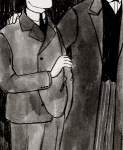
“He would not call his relationship with the Yarder friendship by any means, but there is a mutual regard that exists between the two that apparently runs deeper than he had previously thought.” (x)
Kristina: Okay, next question — let’s get one that’s not Rupert Graves. Okay, this is from Commish24 — in canon and films he’s always portrayed as lower class than Holmes or Watson. Why does this Victorian prejudice continue?
Lyndsay: Interesting. He’s kind of an everyman, a guy’s guy. He is typical of the police at the time, if you’re going to talk history. The police were not paid all that well, so it was a working class job and it was not a job a gentleman would go into, if you were a police officer.
Kristina: If you were a gentleman, you’d be a judge.
Lyndsay: Oh, totally. So culturally that made perfect sense. You wouldn’t become a police inspector — well, first of all he would have risen through the ranks from being a roundsman. So he would have been a roundsman first, and he would have shown aptitude and grit and awesomeness, and then eventually he would have been promoted to being a detective or an inspector. And to go into that job in the first place meant that you were working class. It also meant that you were somebody who needed a day job, you needed a paycheck. So this was not necessarily like a profession that, say for example, Sherlock Holmes would have felt the need to enter. Sherlock Holmes had some money troubles in A Study in Scarlet, but not sufficiently that he needed a day job, and Lestrade would have, culturally speaking. So that actually makes sense.
Kristina: Also on top of that, the police force was still quite young in London at that point as an organization.
Lyndsay: Sure. The Peelers had been founded in the 1820s, I think.
Kristina: So relatively speaking it was less than a hundred years old.
Lyndsay: Absolutely. It was something like 16 years old when Lestrade would have been joining them, so it was not a system that was particularly well-liked, it was not a system that was particularly well-organized, but they were intuitive and they were awesome. They were one of the earliest police forces, actually — Paris and London were very, very early for forming police. It took until 1845 for the New York police force to be founded. The Peelers were a model for everyone thereafter, and they should get mad credit. Lestrade’s peeps, they changed law enforcement. The London force really did.


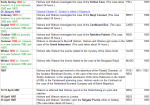




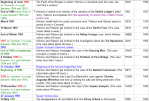


So, after having tried my hand at a timeline of the BBC Sherlock series, I’ve recently put myself at a much more complicate and ambitious task – that is, a chronology of the original ACD’s Canon.
Of course, any attempt at such an enterprise is an hazard, as we know how sloppy Doyle could be with dates and other chronological details…
And this is, naturally, only my PERSONAL timeline: I intentionally avoided to go back to my Baring-Gould or other chronologies, compiled by other people, so as not being influenced.
Some brief clarifications, before I leave this post open to asks and replies:
- I found myself forced to anticipate what I thought to be Sherlock Holmes’ birthdate: I noticed that, in GLOR, it’s said that the Gloria Scott sunk in 1855, and thus Victor Trevor could hardly be born before the end of 1957; but Holmes and Trevor were fellow students at college, so Holmes must be born in 1857, too.
This, however, would also be congruent with what Watson tells us in VEIL about the duration of Holmes’ career and of their active cooperation.- I inserted a specific note about the controversial question of the date and duration of Watson’s first marriage. Here we have TWO thorny issues to handle: 1) From SIGN it would seem that Watson and Mary Morstan got engaged and then married in 1888, but from many hints in other stories (mainly NOBL, SCAN and FIVE) it appears more likely that all the events portrayed in SIGN – thus including Watson’s engagement and, possibly, his marriage – actually happened one year before, in 1887; if this were true, many of the cases I placed in 1889 could instead have occurred in 1888. 2) Through all the years 1889 and 1890 Watson appears alternatively to live with his wife and be in practice, and to live in Baker Street with Holmes; this is the main reason why some scholars have hypotesized that Watson’s marriage with Mary Morstan only lasted some few months, and Watson then married ANOTHER woman before 1891; I, however, cannot agree with this theory, as the periods of lodge-sharing and those of matrimonial life appear completely intermingled between 1889 and 1890: my take on it is that Mary’s health deteriorated quite soon after her marriage and she was frequently absent, to a sanatorium, or an asylum, or on trips in more salubrious places than London; another possibility (which I’ve already stated), which is linked to the fact that Holmes and Watson, in VALL, appear aware of the existance and crimes of Moriarty much before 1891, is that Watson actually kept Mary away most of the time during the years in which Holmes and him investigated Moriarty’s organization, in order to keep her safe from possible threats.
And now I’ll leave this open for comments and further speculation on your part.
Cheers!
[?]
Holy SHIT.


One of the rare cases when I draw something more than person’s face. I’m just too lazy and get bored too easily.
But in this case… Well, one simply cannot resist Jeremy Brett striking a pose 😉

 Lady Karasu
