(reblogged from lunarblue21)
by Leia Fee, with additions by Susannah Shepherd
Quick Contents
- Introduction
- General remarks
- What’s normal?
- Reactions to injury – including emotional reactions, fainting and shock.
- Minor injuries – such as bruises, grazes and sprains
- Head injuries – from black eyes to severe concussions
- Broken bones
- Dislocated joints
- Cutting and Piercing – for various locations, including blood loss symptoms and figures.
- Blunt trauma – getting hit, internal injuries.
- Burns – including electrical burns
- Hostile environments – such as extreme cold and heat, oxygen deprivation and exposure to vacuum.
- References – useful websites.
Introduction
Characters climbing cliffs with broken arms or getting knocked out for an hour or so and then running around like nothing happened, bug me. It doesn’t take much longer to get it right, and I’ve found that getting doing the research to get it right can often lead to whole new story possibilities I hadn’t thought of before.
I’m not any sort of medical expert – research for this article has come from a variety of sources from medical texts to personal experience – (I’m just a teeny bit accident prone…) I do historical reenactment and a large part of information here comes from the ‘traumatic injury’ (or ‘the nasty things that can happen to you in combat’ information we give the public and new members to make them go ‘urggh , I’m glad this isn’t for real’.
Tag: writing tools
Hemingway is a writing checker that is absolutely brilliant.
- checks all spellings for you
- checks if you’re over-using adverbs
- picks out over-complicated sentences
- suggests replacements for over-complicated phrases
- picks out the passive voice
- tells you how readable your text is (Grades/College level/etc)
- calculates reading time
USE IT. USE IT FOR YOUR FANFICS. USE IT FOR YOUR PAPERS. IT WILL SAVE. YOUR. LIFE.
!?!?!?
Looking for a random cause of death for a character? Click here.
Looking for a random city? Click here.
Looking for a random city that people have actually heard of? Click here.
Need a random surname for a character? Click here. (They also give prevalence by race, which is very helpful.)
Helpful writing tips for my friends.
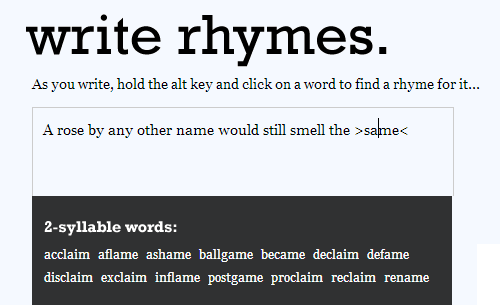
Write Rhymes finds rhymes for your words while you write and takes the weirdness out of poetry and scheming.
Coooool!
I DON’T THINK YOU UNDERSTAND JUST HOW AMAZING THIS IS FOR WRITERS
LIKE
WE SPEND YEARS FILLING NOTEBOOKS WITH RHYMES FOR WORDS AND PHRASES AND END-RHYMES AND SLANT RHYMES AND THEN ONE DAY SOMEFUCKING
GENIUS
GOES
“YOU KNOW WHAT’D BE COOL? MAKING EVERY POET WET THEMSELVES WITH FUCKING JOY”
I” M SO FUXKC I NG
10 Things Writers Don’t Know About The Woods – Dan Koboldt
10 facts about the woods that most writers are getting wrong.It’s hard to put a number on how many books I’ve read that feature characters in the woods. Sometimes they’re fleeing, sometimes chasing, sometimes just looking for something to eat.
As someone who spends a lot of time in the woods, I should tell you that most authors get it wrong. Here are ten realities about the woods that every writer should know.
Ahhh! This is so cool!
An author was writing historical fiction, and decided (in hopes of escaping anachronistic language) to only use the vocabulary that Jane Austen used. They made a custom dictionary of all the words Jane Austen used in all of her books, and used that to spell check, so it flagged modern words and phrases that she would have totally overlooked otherwise.
I’m thinking it would be incredibly easy to do the same thing for fanfiction, especially book-based – compile a dictionary of, say, all the words GRRM used in ASOIAF, and use that as a spell check dictionary so it would flag any words GRRM did not use…
Or a particular TV show character’s dialogue, though that would involve much more manual effort…
edit: apparently, some historical fiction authors use old dictionaries (circa: 1700-1800s) as their custom dictionaries, even when writing about much earlier time periods. This helps them escape writing with modern-sounding anachronisms that throw modern readers out of the story, but also allows them to use language that a modern reader can understand when writing about time periods where characters should be speaking, say, Old English.
friendly reminder that such a thing has been developed for the les mis fandom
These are some great resources for authors of historical fiction (and/or fan fiction)!
Man, and I’ve just been doing this manually and relying on assistance from betas for my Regency stuff…
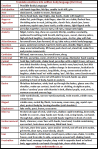
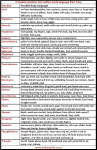
Cheat Sheets for Writing Body Language
We are always told to use body language in our writing. Sometimes, it’s easier said than written. I decided to create these cheat sheets to help you show a character’s state of mind. Obviously, a character may exhibit a number of these behaviours. For example, he may be shocked and angry, or shocked and happy. Use these combinations as needed.



                     Write Real People
                    click and drag game
- ONE RULE: DON’T CLICK AND DRAG UNTIL YOU FIND SOMETHING YOU LIKE!
- if you want me to add anything just write me. i’ll add that and update the post!
I love all the click and drag games on Tumblr and after I read an article about diversity in YA books, I wanted to make a click and drag “game” myself. (i think this was the article, but i’m not sure, sorry)
sortabentglasses this is really freakin cool
this is so cool!
How to Edit Your Own Writing
Like most newspaper reporters, I got into the biz because a) I love writing and b) I’m pretty good at it. But it’s a sobering profession. You file your masterpiece, only to find your editor thinks it’s two dozen “tinks” shy of publishable. Repeat this scenario a couple hundred times, and you’ll find you’ve grown some thick skin. You’ve also gotten pretty darn good at self-editing. So, I’m here to impart some wisdom on the art of quickly perfecting your own workâhow to hone, trim, and morph clumsy words and phrases into a clear, concise message that will wow your audience.Check out Caroline McMillan’s Life Hacker article on editing your own writing, it contains some great tips.
site that you can type in the definition of a word and get the word
site for when you can only remember part of a word/its definition
THAT FIRST SITE IS EVERY WRITER’S DREAM DO YOU KNOW HOW MANY TIMES I’VE TRIED WRITING SOMETHING AND THOUGHT GOD DAMN IS THERE A SPECIFIC WORD FOR WHAT I’M USING TWO SENTENCES TO DESCRIBE AND JUST GETTING A BUNCH OF SHIT GOOGLE RESULTS
 Lady Karasu