That point in a piece of fanfiction where you can tell something embarrassing is about to happen so you start fucking around on tumblr because you’re a huge baby with a crippling overabudance of empathy.
I do this with every media I consume. I pause movies and have to walk around and prepare myself for second-hand embarrassment sometimes.
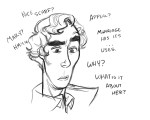
Sure, Sherlock doesn’t care about politics, but this was information on someone he thought was important for a case. So what’s the deal?
Could’ve been a mistake. Could’ve been avoiding connecting any current real-world government official with terrorism. Could’ve been a lot of things.
But it also maybe maybemaybe could’ve been an obscure Easter egg?
Because Mark Gatiss is a fan of Monty Python. And they did a sketch where John Cleese played the Minister for Overseas Development and got to deliver the line, “Don’t be so sentimental—things explode ever day.”
When I started writing Sherlockfic, it was Sherlock who intimidated me, Sherlock I avoided at all costs, for thousands of words, because he seemed like this complex little enigma. But there’s something about Sherlock, once I started writing him, that I found endearingly straightforward. You almost always know where you stand when it comes to Sherlock Holmes.
It’s John who is the tricky one, John who is so maddeningly unpredictable. He seems so dull and unassuming, but, once you’ve written him, it takes roughly two sentences before you realize exactly why Sherlock is so fixated on him. He could be every adjective in the book, really. He is loyal and devoted but he’s also stubborn and independent. He follows Sherlock—as all Watsons must—and he tries to blend into the shadows cast by that overdramatic coat, but if you’ve spent any time at all thinking about him—and Sherlock has—then he’s really the star of the pairing. He is superhumanly tough, cool and calm under pressure, uncowed and unintimidated, but he is also very comfortably human at the same time, friendly and smiling. He likes to laugh and has a good sense of humor and people like him instinctively but he’s essentially a loner at heart and has few close friends, not that any of his acquaintances—other than Sherlock—would ever really stop to consider that, because John is mainly affable and easy-going and can fool anyone into thinking that he’s the most popular person there is.
Almost every time I write John, he manages to have some reaction, some line of dialogue, that surprises me. He’s so very good at rolling with all of Sherlock’s punches, until the moment when he isn’t anymore, and I don’t think I know that line any more than Sherlock does.
He’s with Sherlock because Sherlock attracts him irresistibly, exerts a magnetic pull over him, keeping him in orbit—and, again, that’s how Watsons are—but he’s also with Sherlock because he wants to be with Sherlock. And how Martin Freeman embodies that so beautifully has impressed me more and more and more the more I go back to the canon to check up on my John. Sherlock may be an undeniable hurricane-strength force whirling through John’s life but John also chose him. He wasn’t just pushed around by the fate of it all, he likes Sherlock, he likes his life with him, he’s there because he wants to be.
At least, that’s how I read John Watson. And that’s how I write John Watson. And I like my John, I really do, but it’s taken me several hundred thousand words to figure out what I think Sherlock saw as soon as he looked at him: that it’s John Watson who’s the complicated one.
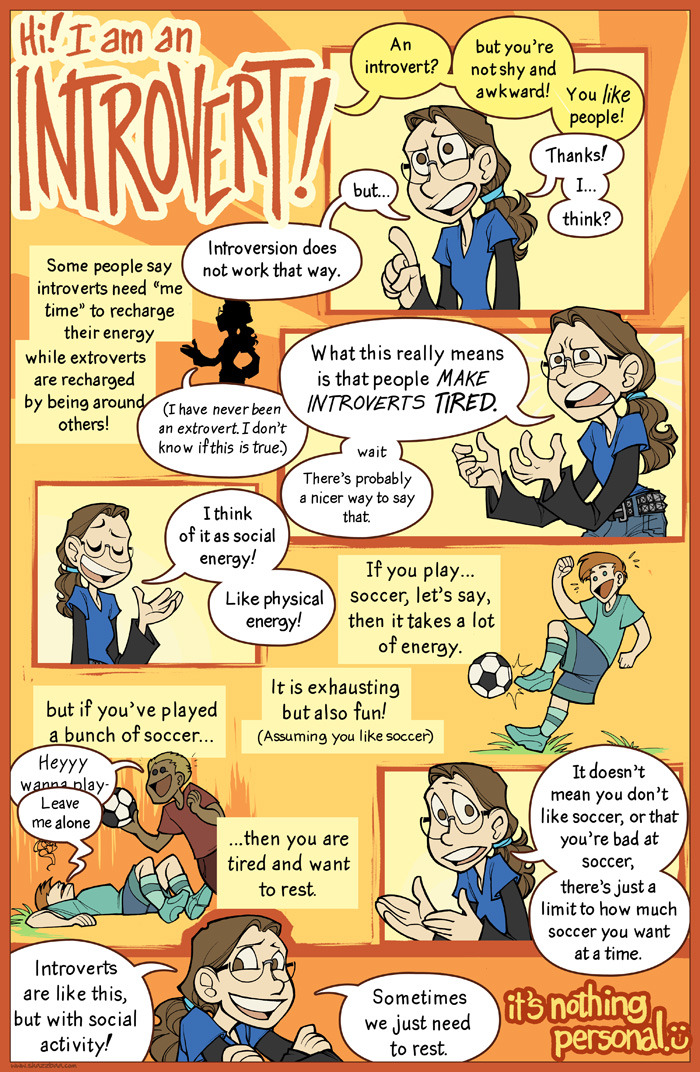
There are a LOT of “how introverts work” infographics and explanations on the internet. Some of them are really good! But I still like this one. c: It’s an analogy my extroverted friends could get behind that doesn’t also imply that I’m a special snowflake princess that must be treated JUST SO.
So I made a poster! *u* Perhaps it would be handy to hang up in your room or dorm???????? If you’re coming to OTAKON this weekend you should stop by The Athena Studio table and pick one up!
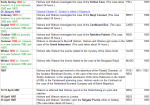
So, after having tried my hand at a timeline of the BBC Sherlock series, I’ve recently put myself at a much more complicate and ambitious task – that is, a chronology of the original ACD’s Canon.
Of course, any attempt at such an enterprise is an hazard, as we know how sloppy Doyle could be with dates and other chronological details…
And this is, naturally, only my PERSONAL timeline: I intentionally avoided to go back to my Baring-Gould or other chronologies, compiled by other people, so as not being influenced.
Some brief clarifications, before I leave this post open to asks and replies:
I found myself forced to anticipate what I thought to be Sherlock Holmes’ birthdate: I noticed that, in GLOR, it’s said that the Gloria Scott sunk in 1855, and thus Victor Trevor could hardly be born before the end of 1957; but Holmes and Trevor were fellow students at college, so Holmes must be born in 1857, too. This, however, would also be congruent with what Watson tells us in VEIL about the duration of Holmes’ career and of their active cooperation.
I inserted a specific note about the controversial question of the date and duration of Watson’s first marriage. Here we have TWO thorny issues to handle: 1) From SIGN it would seem that Watson and Mary Morstan got engaged and then married in 1888, but from many hints in other stories (mainly NOBL, SCAN and FIVE) it appears more likely that all the events portrayed in SIGN – thus including Watson’s engagement and, possibly, his marriage – actually happened one year before, in 1887; if this were true, many of the cases I placed in 1889 could instead have occurred in 1888. 2) Through all the years 1889 and 1890 Watson appears alternatively to live with his wife and be in practice, and to live in Baker Street with Holmes; this is the main reason why some scholars have hypotesized that Watson’s marriage with Mary Morstan only lasted some few months, and Watson then married ANOTHER woman before 1891; I, however, cannot agree with this theory, as the periods of lodge-sharing and those of matrimonial life appear completely intermingled between 1889 and 1890: my take on it is that Mary’s health deteriorated quite soon after her marriage and she was frequently absent, to a sanatorium, or an asylum, or on trips in more salubrious places than London; another possibility (which I’ve already stated), which is linked to the fact that Holmes and Watson, in VALL, appear aware of the existance and crimes of Moriarty much before 1891, is that Watson actually kept Mary away most of the time during the years in which Holmes and him investigated Moriarty’s organization, in order to keep her safe from possible threats.
And now I’ll leave this open for comments and further speculation on your part.





























 Lady Karasu